
A deep ache in one buttock that gets worse the longer you sit can be hard to shake off. Sometimes it runs down the back of your thigh and feels like sciatica. If a GP or physiotherapist has mentioned piriformis syndrome, gentle stretching and hip strengthening are usually where self-help starts.
This guide covers 7 exercises for piriformis syndrome, with simple steps, how long to hold each stretch and how often to do them. It also explains what to avoid and when to get help. If you are not sure what is causing your pain, a physiotherapy assessment can check before you start.
Key takeaways
- Gentle movement is usually better than resting for sciatica-type pain.
- Stretches should feel gentle. Ease off if your pain increases.
- Strengthen your hip muscles as well as stretching them.
- Some symptoms need urgent help, so learn the NHS warning signs below.
What is piriformis syndrome?
Piriformis syndrome is buttock pain, sometimes with sciatica-like symptoms down the leg. It is thought to happen when the piriformis muscle irritates or squeezes the sciatic nerve. A 2019 review in the journal PM&R calls it a relatively uncommon form of sciatica caused by this pressure on the nerve.
The piriformis is a small, deep muscle that runs from the base of your spine to the top of your thigh bone. The sciatic nerve, the large nerve that runs from your lower back down each leg, passes right beside it.
An updated review of the research found four features that come up most often:
- pain in the buttock
- pain that is worse when you sit
- tenderness near the bony notch at the back of the pelvis
- pain when the muscle is put under tension
Experts still debate the diagnosis, and there is no single accepted test for it. Other problems can cause similar pain, and the NHS sciatica page lists causes such as a slipped disc. If you are unsure, read our guide to sciatica symptoms and causes.
Is it safe to exercise with piriformis syndrome?
For most people, yes. NHS advice for sciatica is to carry on with your normal activities as much as you can. It also says to start gentle exercise as soon as possible.
Start slowly and keep each movement comfortable. For its own sciatica exercise videos, the NHS says to stop an exercise straight away if you feel pain or become unwell. Contact 111 if you are worried about your symptoms.
Get urgent help
Ask for an urgent GP appointment or contact NHS 111 if your pain is severe and started suddenly, or it is getting worse quickly. Call 999 or go to A&E if you have:
- pain, tingling, weakness or numbness in both legs
- a loss of feeling around your genitals or bottom
- changes in your bladder or bowels, such as not being able to pee or control when you pee or poo
These warning signs come from the NHS back pain guidance.
7 exercises for piriformis syndrome
You will need an exercise mat, a sturdy chair and about 10 minutes. Move slowly, breathe normally and keep every stretch gentle. Start with the stretches, then add the strengthening moves to build a short piriformis syndrome workout.
1. Knee-to-opposite-shoulder stretch
- Lie face up on your mat with both legs straight.
- Bend the knee on your sore side and hold it with both hands.
- Gently draw the knee towards your opposite shoulder until you feel a stretch deep in your buttock.
- Hold, then slowly lower the leg.
Hold 15–30 seconds · repeat 2–4 times. This is a simple piriformis stretch to start with, and the holds follow the Alberta Health Services piriformis exercise sheet. You should feel a stretch, not pain.
2. Lying figure-four stretch
- Start face up on the mat, then bend both knees and place your feet flat on the floor.
- Cross the ankle of your sore side over the opposite knee.
- Gently push the crossed knee away from you, or hold the back of the other thigh and ease it towards your chest.
- Hold, then swap sides.
Hold 15–30 seconds · repeat 2–4 times. Keep your head and shoulders relaxed on the mat.
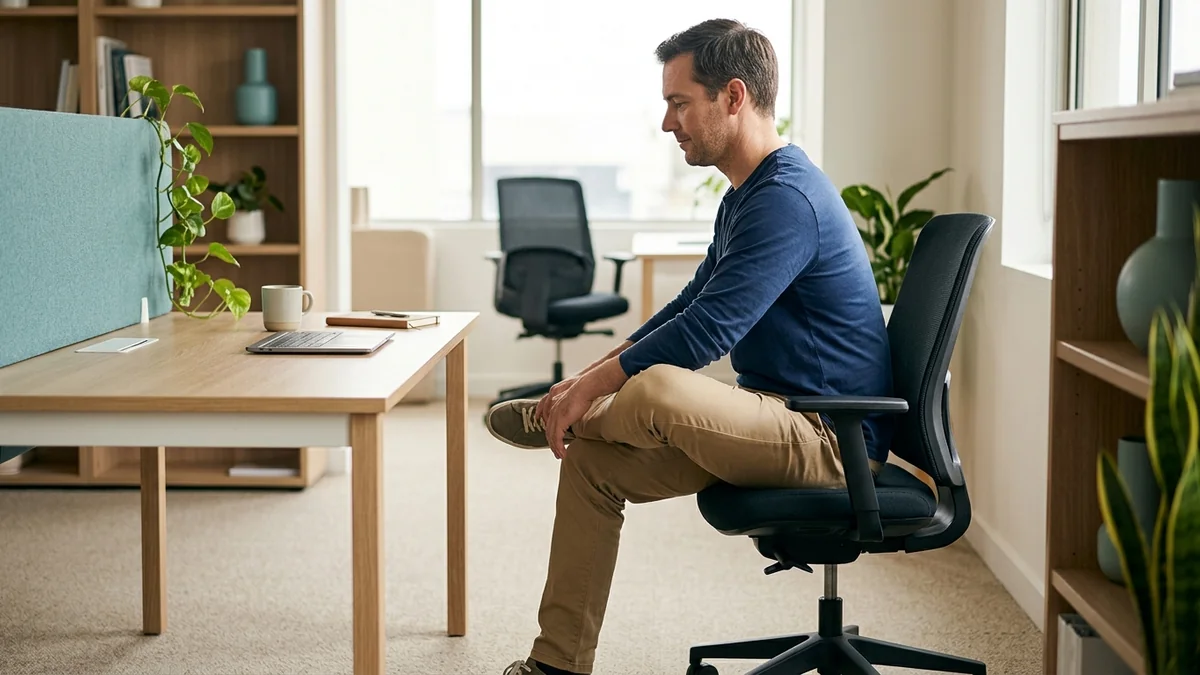
3. Seated piriformis stretch (desk version)
- Sit tall on a sturdy chair with both feet flat on the floor.
- Rest the ankle of your sore side on the opposite knee.
- Let the crossed knee drop gently towards the floor.
- Keep your back straight and lean forward a little from your hips until you feel the stretch.
Hold 30 seconds · 3 times each side, twice a day. This is the seated option suggested in Cleveland Clinic’s piriformis exercise guide, and it is handy on long desk days.
4. Glute bridge
- Lie face up, bend your knees and set your feet flat, about hip-width apart.
- Squeeze your buttocks and lift your hips until your shoulders, hips and knees form a straight line.
- Pause, then lower slowly.
10 reps · 3 sets · once or twice a day. Bridges strengthen the large buttock muscles that work alongside the piriformis.

5. Clamshell
- Lie on your side with your hips and knees bent and your heels together.
- Keeping your feet together, lift your top knee like a clamshell opening.
- Stop before your pelvis rolls backwards, then lower slowly.
10 reps each side · 3 sets · once or twice a day.

6. Side-lying leg lift
- Lie on your side with your bottom knee bent for balance.
- Keep your top leg straight and lift it a little, slightly behind your body.
- Lower it slowly without letting your hips roll.
10 reps each side · 3 sets · once or twice a day.
7. Lying leg march
- Start face up on the mat with your knees bent.
- Gently draw your belly button towards your spine and keep breathing normally.
- Lift one foot until the knee sits above your hip, then lift the other to match.
- Lower one leg at a time, keeping your back still.
Alternate legs until each one has lifted 8–12 times. This trains the lower tummy muscles that help steady your pelvis.
How often should you do piriformis syndrome exercises?
Stretch every day, up to twice a day, and do the strengthening moves once or twice a day. Start with fewer reps and build up as the exercises get easier.
| Exercise | What it works | Hold or reps | How often |
|---|---|---|---|
| Knee-to-opposite-shoulder stretch | Buttock and hip | 15–30 seconds, 2–4 times | Up to twice a day |
| Lying figure-four stretch | Buttock and hip | 15–30 seconds, 2–4 times | Up to twice a day |
| Seated piriformis stretch | Buttock and hip | 30 seconds, 3 times each side | Twice a day |
| Glute bridge | Buttock muscles | 3 sets of 10 | Once or twice a day |
| Clamshell | Side of the hip | 3 sets of 10 each side | Once or twice a day |
| Side-lying leg lift | Side of the hip | 3 sets of 10 each side | Once or twice a day |
| Lying leg march | Lower tummy muscles | 8–12 lifts each leg | Build up gradually |
If an exercise makes your pain worse, do fewer reps or a gentler version, then build back up. The NHS says sciatica usually gets better in a few weeks to a few months. That applies to sciatica in general, not piriformis syndrome specifically.
If you would like a plan built around your own hips and daily routine, we can put together a tailored exercise programme.
Piriformis syndrome exercises to avoid, and habits that help
Avoid forcing deep stretches, bouncing into a stretch or pushing through sharp pain. These can irritate an area that is already sore.
- Long spells of sitting: pain that is worse when sitting is one of the most common features. Cleveland Clinic’s physical therapist suggests standing up briefly every half hour.
- Long drives and desk days: plan short breaks to stand and move, and use the seated stretch above.
- Pushing through pain: ease off if your pain increases, as the Alberta guidance advises.
- New symptoms: if you notice new numbness, tingling or weakness, stop and get advice from NHS 111 or your GP.
When to see a physiotherapist
See a physiotherapist if your pain is not easing after a few weeks of regular exercise, keeps coming back, or you are not sure what is causing it. An assessment can check for other causes of buttock and leg pain.
Physiotherapy is free on the NHS, but waiting times can be long, and you can also see a physiotherapist privately. In many areas you can refer yourself to NHS musculoskeletal (MSK) services without seeing a GP first.
Physiotherapy usually combines exercise, advice and, where suitable, manual therapy. NICE’s guideline on low back pain and sciatica recommends manual therapy only as part of a treatment package that includes exercise. At Prime Physiotherapy Clinic, that may mean hands-on treatment or trigger point therapy alongside your exercises, if your physiotherapist thinks they suit you.
FAQs about piriformis syndrome exercises
Can you exercise with piriformis syndrome?
Yes, in most cases. The NHS advises keeping active and starting gentle exercise as soon as you can for sciatica-type pain. Choose comfortable movements, ease off if your pain increases, and stop and get advice if you feel unwell or your symptoms worry you.
How do you stretch the piriformis muscle?
Lie on your back and draw one knee gently towards the opposite shoulder, or cross one ankle over the other knee in a figure-four position. Hold for 15–30 seconds and repeat 2–4 times. You should feel a gentle stretch deep in your buttock.
How do I strengthen my piriformis and hip muscles?
Glute bridges, clamshells and side-lying leg lifts work the buttock and hip muscles around the piriformis. Cleveland Clinic’s physical therapist suggests 3 sets of 10, once or twice a day. Start with fewer reps if you need to and build up.
Can you over-stretch the piriformis?
Stretching harder does not help more. Stretches should feel gentle, and the Alberta Health Services guidance is to ease off if you start to have pain. Avoid bouncing or forcing a stretch, especially while the area is sore.
Is it piriformis syndrome or sciatica?
Piriformis syndrome is often described as a type of sciatica, caused by the piriformis muscle pressing on the sciatic nerve. Other problems, such as a slipped disc, can cause similar pain, and there is no single reliable test. A physiotherapist or GP can help work out the likely cause.
Book a physiotherapy assessment in Birmingham
Exercises for piriformis syndrome work best when you do them regularly and match them to your symptoms. If your buttock pain is not settling, or you would like a clear plan, Prime Physiotherapy Clinic can help.
Our clinic is at Suite 3A, Cobalt Square, 83–85 Hagley Road, Birmingham B16 8QG, and we are open Monday to Sunday, 9am to 9pm. Book your assessment online, or call or WhatsApp us on +44 7944 274894.