Osteopaths and physios both treat muscle and joint pain. Both are health professions with titles protected by law. The big differences are how they work and how you can see them.
Physios are registered with the HCPC and work across the NHS and private clinics. They use exercise, hands-on treatment and advice. Osteopaths are registered with the GOsC, mostly work privately and focus on hands-on techniques.
This osteopath vs physio guide compares training, rules, treatment style and NHS access. It also explains where chiropractors fit and helps you decide who to see. If you already know you want physio, you can book a physiotherapy assessment.
Key takeaways
- Both titles are protected by law, so always check the official register.
- Physio is free on the NHS, though waiting lists can be long. You can also pay privately.
- The NHS groups osteopathy and chiropractic with complementary therapies and lists safety cautions.
- For low back pain and sciatica, NICE says hands-on treatment should come with exercise.
Osteopath vs physio at a glance
The quickest way to compare an osteopath versus a physiotherapist is side by side. We have added chiropractors too, because people often compare all three.
| Physio | Osteopath | Chiropractor | |
|---|---|---|---|
| Regulator | HCPC | GOsC | GCC |
| Title protected by law? | Yes | Yes | Yes |
| Training | 3-year degree (4 in Scotland) and 1,000 placement hours | Up to 4 years full-time and at least 1,000 clinic hours | A degree from one of six approved UK providers |
| Main approach | Exercise, hands-on treatment and advice | Massage and stretching | Spinal adjustments, hands-on treatment, exercise and advice |
| On the NHS? | Yes, free, often by self-referral | Listed as a complementary therapy | Listed as a complementary therapy |
| Where to check | HCPC register | GOsC register | GCC register |
In short, all three are regulated. Physio is the one most widely available through the NHS.
What does a physiotherapist do?
Physios help people move better and get back to normal life using exercise, hands-on treatment and advice. The NHS physiotherapy page lists a wide range of problems they treat.
- back pain, neck pain and other joint and muscle problems
- sports injuries, such as sprains and strains
- heart and breathing problems
- problems moving after a stroke
- problems during or after pregnancy
Treatment often includes exercises to improve movement and strength, manual therapy and advice. Some physios also use ultrasound, TENS, hydrotherapy or acupuncture.
“Physiotherapist” is a protected title. You can only use it if you are registered with the HCPC, the Health and Care Professions Council. The Chartered Society of Physiotherapy (CSP) is the professional body.
Most physios train through a 3-year degree, or 4 years in Scotland, with 1,000 hours of placements. Physio is free on the NHS, but there may be a long wait. In many areas you can refer yourself.
At our clinic, physio includes exercise rehab, hands-on treatment and acupuncture where it suits you.

What does an osteopath do?
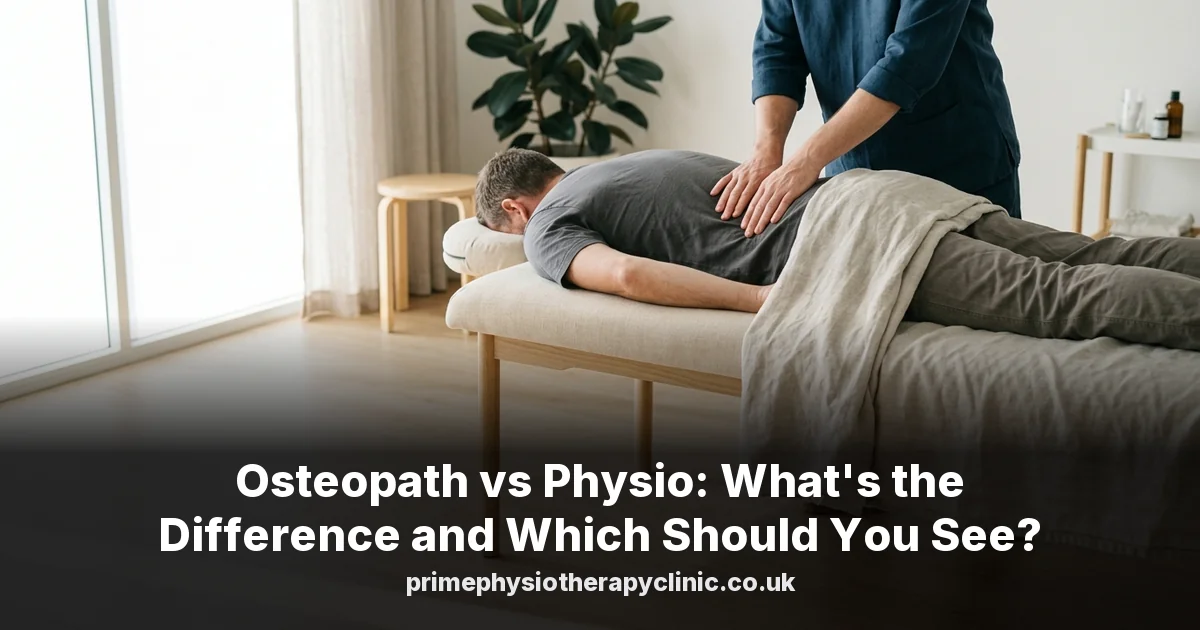
Osteopaths treat muscle and joint problems mainly with their hands. The NHS describes osteopathy as using massage and stretching to treat injuries, improve movement and relieve pain.
The title “osteopath” is protected by law. It is a crime to claim to be one without being on the General Osteopathic Council (GOsC) register. The Osteopaths Act 1993 set up this system.
Training usually takes up to 4 years full-time, or 5 years part-time. It includes at least 1,000 hours of supervised work with patients.
Advertising rules also shape what osteopaths can claim. The UK’s advertising watchdogs, the ASA and CAP, accept claims for a set list of conditions. These include general back pain, sciatica, minor sports injuries and uncomplicated neck pain.
Claims for other conditions need strong evidence. Most osteopaths work privately.

Key differences between osteopathy and physiotherapy
So what about osteopathy vs physiotherapy in practice? Put simply, the difference between an osteopath and a physiotherapist comes down to four things. These are regulation, training, NHS access and how much each uses exercise.
Regulation and titles
Physios are regulated by the HCPC and osteopaths by the GOsC. Both titles are protected, so a quick check of the register tells you someone is qualified to use it.
Training
Physio is usually a 3-year degree, or 4 years in Scotland, with 1,000 placement hours. Osteopathy training usually runs up to 4 years full-time, with at least 1,000 hours of supervised work with patients.
NHS access
Physio is part of everyday NHS care, and many areas let you refer yourself. The NHS website lists osteopathy under herbal medicines and complementary therapies. It notes that these are not tested in the same way as standard medicines.
Treatment style
Physios usually build treatment around exercise and use hands-on techniques where they help. Osteopaths focus mainly on hands-on techniques such as massage and stretching. There is some overlap, because both can use manual therapy.
Advertising rules
The ASA publishes lists of conditions that osteopaths and chiropractors may claim to treat. These lists apply to those two professions. Claims beyond them need strong clinical evidence.
Where do chiropractors fit?
Chiropractors are a third regulated profession. Like osteopaths, they mainly treat with their hands, with a special focus on the spine.
The General Chiropractic Council (GCC) says chiropractors use spinal adjustments, other hands-on treatment, exercise and lifestyle advice. The title is protected by law. It is a crime to call yourself a chiropractor without being registered.
The Chiropractors Act 1994 set up the GCC. Over 4,000 chiropractors are registered, and six UK providers offer approved degrees.
Two points are worth knowing. Registered chiropractors may use the title “Doctor of Chiropractic” if it is clear and not misleading. ASA guidance says osteopaths without a medical degree should avoid “Dr”.
The NHS also says chiropractic or osteopathy may not be safe for some people:
- if you take blood-thinning medicines, or have a higher risk of bleeding or stroke
- if your bones or joints are very weak or badly damaged
- if you have a nerve condition, such as peripheral neuropathy
Osteopath vs physio: which should you see?
Weighing up physiotherapy or osteopathy? Start with your problem, how you like to be treated and how you want to get care. Whoever you choose, check they are registered.
- You want NHS treatment: physio is the option the NHS provides, often through self-referral.
- You want rehab based on exercise: for example after an injury, an operation or a stroke, physio is built around exercise and getting you moving.
- You have back or neck pain and like hands-on care: both use hands-on techniques. For low back pain and sciatica, NICE says to use manual therapy only as part of a package that includes exercise.
- You take blood thinners, or have weak bones or a nerve condition: tell your practitioner, and note the NHS cautions above.
- Babies, children or pregnancy problems: the ASA says the evidence for osteopathy and chiropractic is limited or negative for conditions specific to these groups.
If physio sounds right for you, start with a physiotherapy assessment.
When to get urgent help instead
Some back and leg symptoms need urgent medical care, not a physio or osteopath. The NHS back pain guidance says to call 999 or go to A&E if you have:
- pain, tingling, weakness or numbness in both legs
- a loss of feeling around your genitals or bottom
- changes in your bladder or bowels
For severe pain that started suddenly or is getting worse quickly, ask for an urgent GP appointment or contact NHS 111.
How to check a practitioner is registered
Checking a register takes a couple of minutes. It is the simplest way to protect yourself. If you cannot find a name, ask about it before you book.
- Physio: search the HCPC register by profession and surname or registration number. For a private physio, the NHS also suggests looking for MCSP after their name.
- Osteopath: search the GOsC register.
- Chiropractor: use the GCC’s Find a Chiropractor search.
- Other therapists: the NHS suggests checking they are on a register approved by the Professional Standards Authority.
Questions to ask before you book
A few simple questions help you compare any physio, osteopath or chiropractor before your first visit.
- Are you registered, and can I check your name on the register?
- What will my treatment involve: exercise, hands-on treatment or both?
- Will I get exercises to do at home between sessions?
- How will we know if the treatment is working?
- What happens if I am not getting better?
- Is there anything about my health you need to know first, such as my medicines?
A good practitioner will be happy to answer. Clear answers also help you choose with confidence.
FAQs about osteopaths and physios
Is osteopathy the same as physiotherapy?
No. They are separate professions with their own regulators: physios register with the HCPC and osteopaths with the GOsC. Their training is different too, and physio is the one widely available on the NHS.
Physio vs osteopath: which is better?
Neither is better for everyone, as it depends on your problem, how you like to be treated and whether you want NHS care. For low back pain and sciatica, NICE says hands-on treatment should be used alongside exercise. Whoever you see, check they are registered.
Can you see an osteopath and physio at the same time?
Yes, some people do. If you see both, tell each one about the other’s treatment and any exercises you have been given, so your care fits together.
Should I see a physio or an osteopath for sciatica?
The NHS lists physiotherapy, including exercise advice and manual therapy, among the main sciatica treatments. Osteopaths may also advertise treating sciatica under ASA rules. NICE says to combine any hands-on treatment with exercise, and our sciatica guide covers exercises and warning signs.
Do I need a GP referral to see a physiotherapist?
Not usually. In many areas you can refer yourself to NHS physio without seeing a GP. Private clinics, including ours, take bookings directly.
Can osteopaths and chiropractors call themselves “Dr”?
Registered chiropractors may use the title “Doctor of Chiropractic” or “Dr”, as long as it is clear and not misleading. Osteopaths who do not have a medical degree should avoid “Dr”, according to ASA guidance.
Physiotherapy at Prime Physiotherapy Clinic in Birmingham
If physio sounds right for you, we can help. Prime Physiotherapy Clinic offers physiotherapy assessments, manual therapy, exercise prescription, trigger point therapy, sports massage, and acupuncture and dry needling. We do not offer osteopathy or chiropractic.
Our clinic is at Suite 3A, Cobalt Square, 83–85 Hagley Road, Birmingham B16 8QG. We are open Monday to Sunday, 9am to 9pm. Read more about our clinic.
Still weighing up osteopath vs physio? Book a physiotherapy assessment, or call or WhatsApp us on +44 7944 274894.