Does the outside of your hip ache when you lie on that side, climb the stairs or stand up after sitting? That is often hip bursitis, which NHS services now call greater trochanteric pain syndrome (GTPS).
This guide gives you hip bursitis exercises with NHS steps and doses, what to avoid and how to ease the pain now. It also covers sleep, recovery time and when to get help.
Not sure what is causing your pain? A physiotherapy assessment can find out.
Key takeaways
- The NHS calls it GTPS: irritated tendons at the side of the hip, rarely just an inflamed bursa.
- Slow, steady strengthening is the main treatment.
- Avoid crossed legs, lying on the sore side and stretches across the hip.
- It often takes months, so start gently and keep going.
What is hip bursitis?
Hip bursitis, also called trochanteric bursitis, is pain on the outside of your hip and thigh. The tissues over the bony point at the side of your hip, the greater trochanter, become irritated. NHS inform calls it greater trochanteric pain syndrome (GTPS).
The old name misleads. NHS Lanarkshire explains that the pain usually comes from small, repeated strains of the buttock tendons (gluteal tendinopathy). Cambridge University Hospitals notes that bursitis on its own showed up in only 2% of patients.
GTPS is common, especially in women and people aged 40 to 60. Leicestershire Partnership NHS Trust says it is not dangerous, and most people improve with the right advice and exercise. So exercises for trochanteric bursitis and for GTPS are the same plan.
Hip bursitis or something else?
Outer hip pain has several possible causes, and the NHS advises against diagnosing it yourself.
| Problem | Clues | What to do |
|---|---|---|
| GTPS (hip bursitis) | Outer hip ache, worse lying on it, on stairs or with crossed legs; rarely spreads below the knee | Start the advice and exercises below |
| Hip osteoarthritis | Over 45; pain worse when walking; stiffness after moving | See a GP or physiotherapist |
| Pain from your lower back | Numbness, weakness or symptoms spreading down the leg | See a GP or physiotherapist |
| Joint infection | Hot, swollen hip with a high temperature | Urgent GP appointment or NHS 111 |
Leg pain with numbness can come from the lower back, as in sciatica. Deep buttock pain may be piriformis syndrome instead. A physiotherapist can check your back and hip joint.
Hip bursitis symptoms
The main symptom is pain on the outside of your hip, thigh or buttock. It is often worse when you lie on that side or press on the area. NHS inform and NHS trust leaflets list these common signs:
- pain when walking, standing or running
- tenderness when you touch the outside of your hip
- pain sitting with your legs crossed
- pain standing on the sore leg, for example when getting dressed
- pain on the stairs
- pain lifting your legs in or out of a car or bed
- pain standing up from a chair and in the first few steps after rest
The pain can spread down your thigh, but usually not below the knee. It is more common in women, and NHS inform says hormone changes may play a part.
What causes hip bursitis?
Often there is no clear reason, but NHS inform lists these factors that may contribute:
- a sudden increase in load, such as walking further or faster than usual
- sitting or standing in one position for too long, or leaning on one leg
- weaker or less flexible muscles around the hip and buttock
- an inactive lifestyle or being overweight
- a fall onto the side of your hip
- hormone changes
- osteoarthritis of the hip or knee, or low back pain
Positions that squeeze the outside of your hip often aggravate it, such as crossed legs, leaning on one hip and low chairs.
Hip bursitis relief: what helps now
The quickest relief comes from changing what aggravates your hip while staying gently active. NHS inform calls finding and changing the activities that cause your pain an important step.
- Stand evenly: weight on both feet, not hanging on one hip.
- Sit well: avoid low chairs, crossed legs, and knees wide apart or squeezed together.
- Take stairs one at a time: use the rail; good leg first going up, sore leg first coming down.
- Use ice or heat: an ice pack in a towel for up to 20 minutes every 2 to 3 hours, or a covered hot water bottle.
- Ask about painkillers: paracetamol or ibuprofen gel can help you keep moving; check with a pharmacist.
- Stay active: keep working if you can, and lose weight if you are overweight.
These tips come from NHS inform, the NHS hip pain page and NHS trust leaflets.
How to sleep with hip bursitis
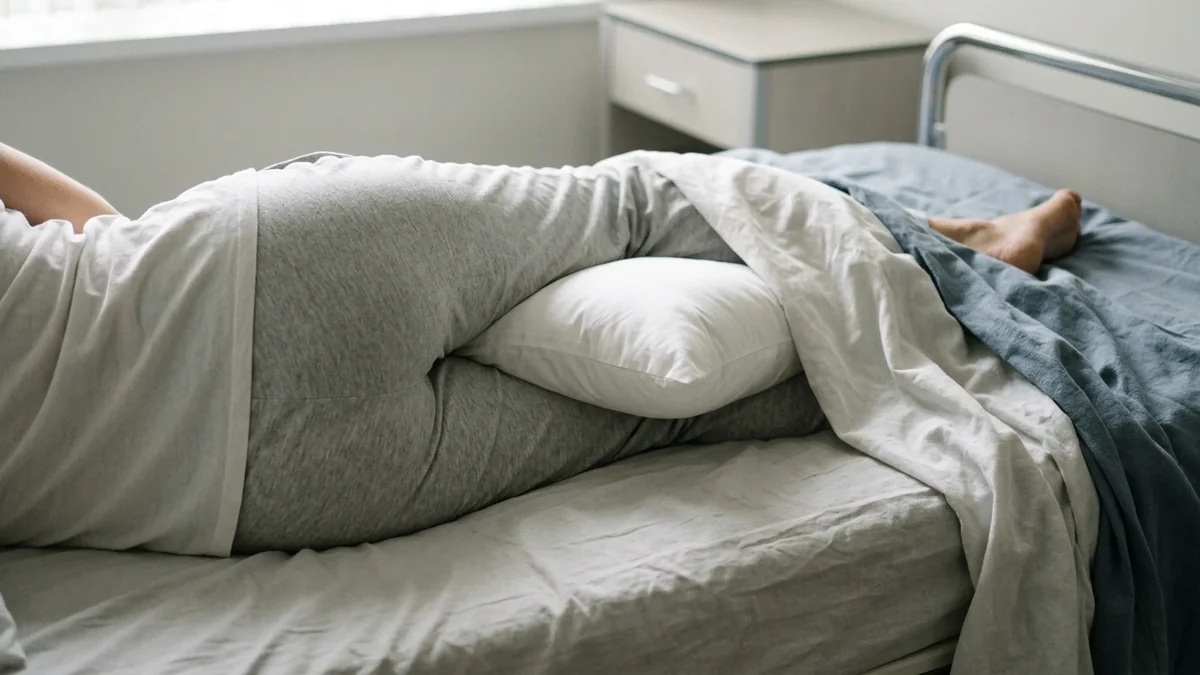
Avoid sleeping on the sore side. Lie on your back with a pillow under your knees, or on your good side with a pillow between your knees.
Physiotherapists at Royal Berkshire NHS Foundation Trust suggest enough pillows to keep your top hip and knee level. This eases pressure on the outside of the hip. A pillow behind your back stops you rolling onto the painful side (Leicestershire Partnership NHS Trust).
6 hip bursitis exercises from NHS physio leaflets
Gentle strengthening of the muscles at the side of your hip is the main treatment. These trochanteric bursitis exercises and doses come from NHS inform and NHS trust physiotherapy leaflets.
How hard and how often?
NHS inform’s guide to GTPS exercises rates pain during exercise out of 10:
- 0 to 3: minimal
- 4 to 5: acceptable
- 6 to 10: too much, so ease off
Above 5, do fewer repetitions, move more slowly or rest longer. If pain builds over the next 24 hours, NHS Lanarkshire suggests doing less for a while. Stop any exercise that makes your symptoms worse or causes new pain.
For the lifts and steps, start with 2 or 3 repetitions at a time, spread through the day. Add 1 or 2 every few days as it gets easier. Later, do sets of 8 with a minute’s rest, 2 to 3 times a day, up to 2 sets of 15.
1. Push out against a belt
- Lie face up with a belt looped around your knees and your legs hip-width apart.
- Press both knees outwards into the belt.
- Hold, then relax.
How much: hold for 15 seconds, 5 to 10 times, twice a day (Kingston and Richmond NHS Foundation Trust).
2. Knee press against a wall
- Stand tall, side-on and close to a wall.
- Bend the knee nearest the wall and rest it against the wall.
- Press that knee into the wall, keeping the hip, knee and foot of your standing leg in line.
How much: hold for 3 seconds, relax, and repeat for 1 minute; do this 3 times (Royal Berkshire NHS Foundation Trust).
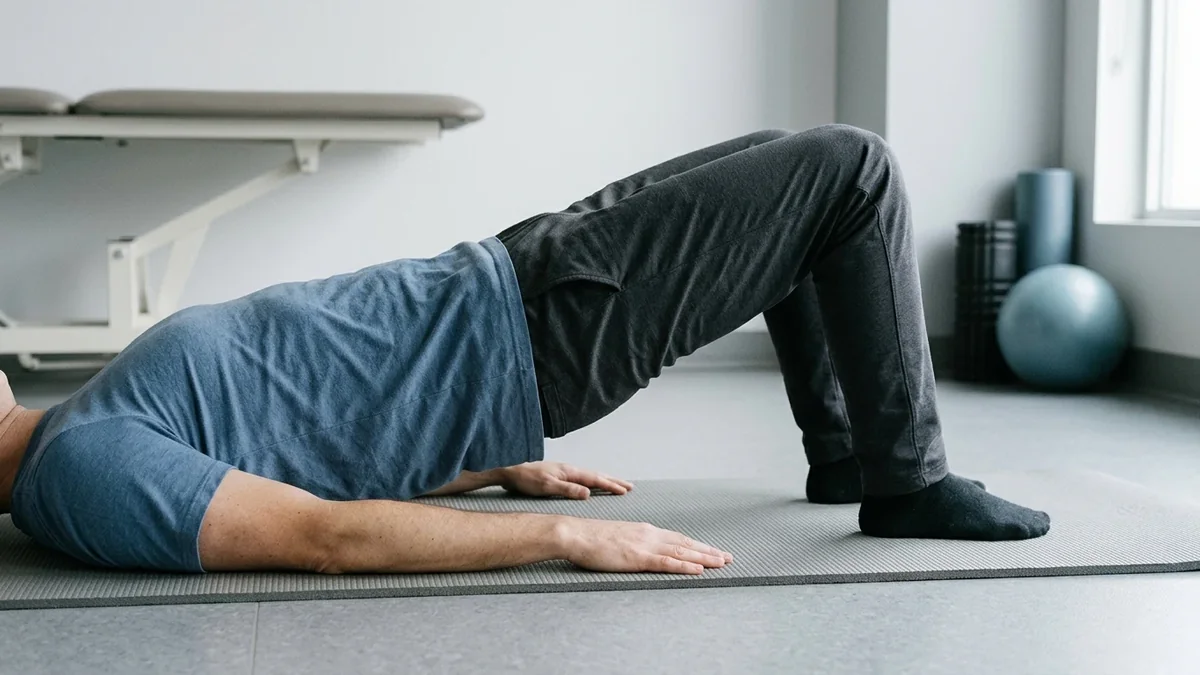
3. Bridge
- Lie face up, knees bent and feet hip-width apart.
- Push through your heels and squeeze your buttocks to lift your bottom as far as is comfortable.
- Lower slowly, and keep breathing throughout.
How much: 8 to 15 times, once a day (Kingston and Richmond NHS Foundation Trust).
4. Chair squat
- Stand in front of a chair with your feet hip-width apart.
- Sit your hips back until your bottom lightly touches the chair.
- Push back up to standing.
How much: 8 to 15 times, once a day (Kingston and Richmond NHS Foundation Trust).
5. Side-lying leg lift with a pillow
- Lie on your good side, painful hip on top, with your head supported and a pillow between your knees.
- Slowly raise your top leg, pause for a few seconds, then lower it.
- Keep the top leg in line with your body, or slightly behind it, never in front.
How much: start with 2 or 3 lifts and build up as above (NHS inform). If lifting hurts, Royal Berkshire’s physios start with the leg just 1 cm off the pillow.
6. Step-up
- Stand facing the bottom stair.
- Step up with your sore leg first.
- Keep that foot on the step and slowly step your other foot up and down.
How much: start with 2 or 3 steps and build up as above (NHS inform).
| Exercise | Stage | Dose in the NHS leaflet |
|---|---|---|
| Push out against a belt | Start here | 15-second hold, 5 to 10 times, twice a day |
| Knee press against a wall | Start here | 3-second holds for 1 minute, 3 times |
| Bridge | Start here | 8 to 15 times, once a day |
| Chair squat | Start here | 8 to 15 times, once a day |
| Side-lying leg lift | Next | 2 or 3 at a time, building to 2 sets of 15 |
| Step-up | Later | 2 or 3 at a time, building to 2 sets of 15 |
| Side stepping (extra) | Later | 8 to 15 steps each way, once a day |
NHS inform has short videos of three of them. NHS trusts also publish printable PDF leaflets of exercises for hip bursitis with pictures, such as Royal Berkshire’s and Leicestershire’s.
A physiotherapist can turn these greater trochanteric pain syndrome exercises into a tailored exercise plan for your hip.
Hip bursitis exercises to avoid
Avoid stretches that pull your leg across your body or stretch the buttock and outer thigh. Go easy on clams and unsupported side-lying lifts at first, because they squeeze the sore tendons.
NHS Lothian’s fact sheet for GPs warns that the clam “may be provocative”, because of friction and compression over the bony point. It adds that stretching the iliotibial band (ITB) is unlikely to help and more likely to provoke pain.
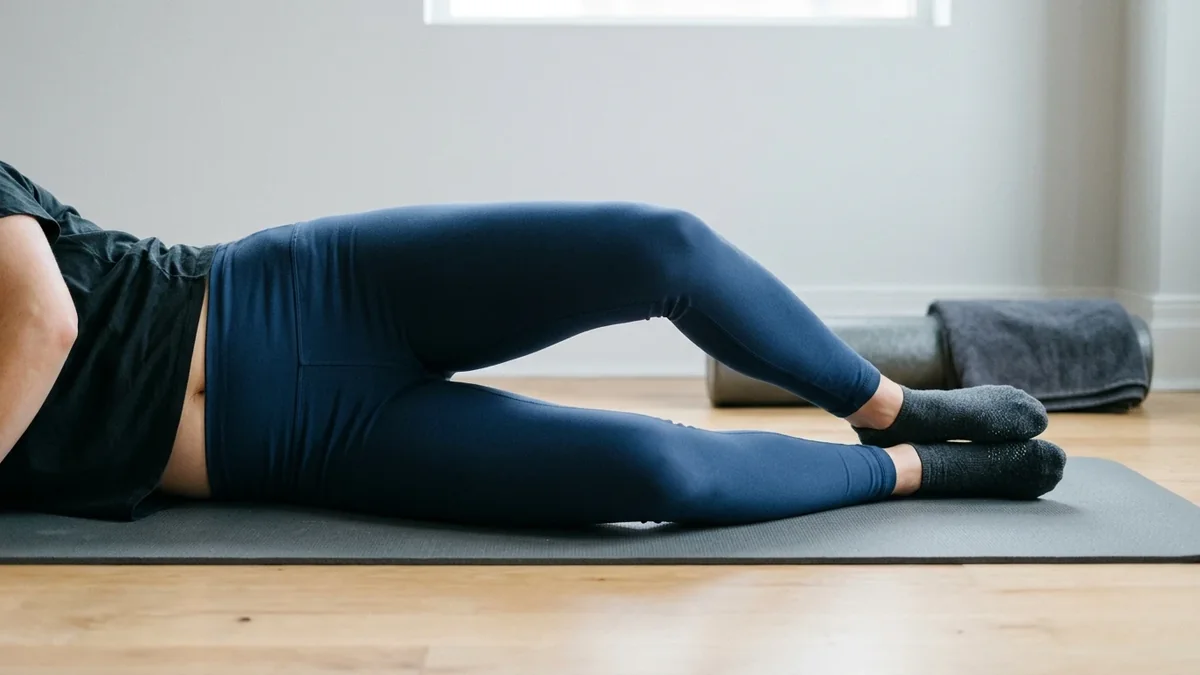
Cambridge University Hospitals also advises against buttock, ITB and strong low-back twisting stretches, and against clams and side-lying lifts in floor Pilates. St George’s physiotherapists say to avoid stretching the hip.
Many online routines include these moves, so check before you copy one. These are the trochanteric bursitis exercises to avoid too. Exercise 5 above is different: NHS inform’s version uses a pillow and keeps your leg in line.
Try clams only if a physiotherapist says they suit you. Two NHS trusts, in Cambridge and Wigan, also advise cutting back on hills, stairs, long walks and running while it is sore.
Can you exercise with hip bursitis?
Yes. NHS Lanarkshire says avoiding all activity can make the pain worse over time. Keep exercising as long as it isn’t making your pain worse.
Hip bursitis and exercise go together, because the right amount is the main treatment. Swimming or cycling may put less stress on your hip. If you run and also have knee pain, see our guide to runner’s knee.
How long does hip bursitis take to heal?
It often takes months. NHS guidance ranges from a first improvement after 8 to 12 weeks to 6 to 12 months of rehabilitation. Flare-ups are normal, and St George’s physios say they don’t mean you have damaged your hip.
| Source | What it says |
|---|---|
| NHS inform | Often 6 to 12 months of rehabilitation to settle, depending on the cause; flare-ups are normal |
| Kingston and Richmond NHS Foundation Trust | Symptoms usually improve within 3 to 6 months |
| Leicestershire Partnership NHS Trust | Most people notice improvement after 8 to 12 weeks; some take up to a year |
| NHS Lothian | Over 90% of people recover without an operation |
Do steroid injections help hip bursitis?
An injection can ease the pain for a while, but it is not the first step. NHS inform says one may be discussed if painkillers aren’t helping, and that it may not cure the condition.
St George’s physiotherapists say injections are no more effective than physiotherapy in the long term and should go alongside it. In a 2018 BMJ trial of 204 people, education plus exercise did better than one injection at 8 weeks. At a year it still gave more overall improvement, though pain levels were similar.
If symptoms don’t settle, a specialist orthopaedic team may offer shockwave therapy or other injections. We don’t provide either; if you might need one, we will advise you to see your GP.
When to see a physiotherapist or get urgent help
Get urgent help for the warning signs below. Otherwise, see a GP if home treatment hasn’t helped after 2 weeks (NHS), or a physiotherapist if GTPS isn’t better after 6 weeks (NHS inform).
Call 999 or go to A&E if:
- you have severe hip pain after a fall or injury
- you can’t walk or put weight on your leg
- you have tingling or loss of feeling in your hip or leg after an injury
Ask for an urgent GP appointment, or contact NHS 111, if:
- you have severe hip pain that started suddenly, without a fall or injury
- your hip is swollen and feels hot
- the skin around your hip has changed colour
- you have hip pain, feel generally unwell and have a high temperature (or feel hot, cold or shivery)
Source: NHS hip pain advice, checked 28 October 2026.
See a GP or physiotherapist, too, if pain stops your normal activities or sleep, or keeps coming back. Numbness, weakness or symptoms spreading down your leg also need checking.
In many areas you can refer yourself to NHS physiotherapy, or book privately with no GP referral. Cambridge University Hospitals says physiotherapy is the best treatment for gluteal tendinopathy on current evidence.
At Prime Physiotherapy Clinic, your physio examines your hip, back and movement, then builds a graded exercise plan. Hands-on treatment can be added where it helps. If you need a scan, an injection or a specialist’s opinion, we explain why and advise you to see your GP.
Book a physiotherapy assessment to get a clear plan for your hip.
Hip bursitis FAQs
Is walking good for hip bursitis?
Yes, in amounts your hip can manage; NHS inform advises keeping active. NHS Lanarkshire suggests limiting steep hills and using a step counter to cut back, then adding steps again slowly.
Is there a test for hip bursitis?
There is no single home test: a clinician examines you, and a scan is not always needed. NHS Lothian lists three clues: pain on pressing the bony point, on pushing the leg out against resistance, and after 30 seconds on one leg.
Can hip bursitis cause a lump or swelling?
Not usually. NHS Tayside’s referral guide says GTPS rarely shows swelling, warmth or redness. A hip that is swollen and hot, or pain with a high temperature, needs an urgent GP appointment or NHS 111.
Book a hip pain assessment in Birmingham
Most people improve with fewer aggravating positions, steady hip bursitis exercises and patience. If yours is not getting better, Prime Physiotherapy Clinic can assess it and plan your next steps.
Every appointment is £50 for 45 minutes, self-pay, with no GP referral needed. Visit us at Suite 3A, Cobalt Square, 83–85 Hagley Road, Birmingham B16 8QG. We are open Monday to Sunday, 9am to 9pm.
Book your assessment online, call or WhatsApp us on +44 7944 274894, or contact us. We aim to reply within 2 hours during opening hours.