
Does your first step out of bed feel like treading on a stone? Or does the back of your heel ache after a walk or a run? Heel pain like this is common, and most people can ease it at home.
Below you will find the likely cause by where it hurts, NHS self-care, 6 exercises with NHS doses, recovery times and when to get help.
If the pain keeps coming back, a physiotherapy assessment can find what is driving it and give you a plan.
Key takeaways
- Plantar fasciitis, a strain under the heel and arch, is the most common cause.
- Most cases ease with self-care, stretching and time, but recovery can take months.
- See a GP if it has not improved after 2 weeks of home care, or if you have diabetes.
- Contact NHS 111 if you heard a snap or cannot walk after an injury.
What causes heel pain?
Heel pain is often caused by overload: too much exercise, long hours on hard floors or extra body weight (NHS). The most common cause is plantar fasciitis, which affects the underside of the heel (NHS Fife).
Where it hurts gives a clue, whether it is your left heel, right heel or both. Use this table as a guide only: the NHS advises against diagnosing the cause yourself.
| Where and when it hurts | Common cause | Source |
|---|---|---|
| Base of the heel, worst with your first steps after rest | Plantar fasciitis | NHS |
| Centre of the heel, a dull ache that builds as you walk | Fat pad syndrome | NHS Lanarkshire |
| Back of the heel, stiff and sore in the morning | Achilles tendinopathy | Sherwood Forest Hospitals |
| Red and swollen, with a dull ache | Bursitis | NHS |
| Sudden sharp pain after an injury, a snap or pop, hard to walk | Broken heel bone or torn Achilles tendon | NHS |
| A child’s heel, during or after sport | Sever’s disease | NHS Fife |
If the pain is severe, or no row fits, get it checked.
Pain under the heel: plantar fasciitis
Plantar fasciitis is a strain of the plantar fascia, a strong band underneath your foot running from the heel bone (calcaneus) to the toes. It causes pain on the bottom of your heel and along the arch (NHS).
The NHS says it is more likely to be plantar fasciitis if:
- the pain is much worse with your first steps after sleep or rest
- it eases as you move, then aches again after long spells on your feet
- raising your toes or climbing stairs hurts
People describe a stabbing feeling, like a nail being driven into the heel, or a sharp, aching or burning pain (Royal National Orthopaedic Hospital). It is more likely if you are 40 to 60, overweight or have tight calves, the NHS says.
The pain is mostly felt under the inside of the heel (North Cumbria NHS podiatry service). Often there is no clear reason, and you do not need an X-ray to diagnose it (MSK Dorset).
Pain behind the heel: Achilles problems
Pain, stiffness and swelling behind the heel, often worse in the morning, are the main signs of Achilles tendinopathy (tendonitis), says Sherwood Forest Hospitals. It can affect where the tendon joins the heel bone, or 2 to 6cm above it. There may be a painful lump that rubs on the back of shoes or boots (Royal National Orthopaedic Hospital).
Our guide to Achilles tendon exercises covers this problem in full.
Do heel spurs cause heel pain?
Usually not. Heel spur pain is a common worry, but a heel spur (calcaneal spur) is a small shelf of bone. The Royal Orthopaedic Hospital in Birmingham says spurs are more common with plantar fasciitis, yet people without pain have them too.
It adds that the spur is not itself the cause, so the advice in this guide still applies.
Fat pad, bursitis and other causes
If the centre of your heel aches more the longer you stand or walk, its fat padding may have thinned. First steps are less painful than with plantar fasciitis (NHS Lanarkshire).
A red, swollen, aching heel may be bursitis, an inflamed fluid-filled sac (NHS).
Less often, a stress fracture, a torn plantar fascia or an irritated nerve is to blame (Royal National Orthopaedic Hospital). Tingling or loss of sensation needs a GP check.
Heel pain in children
In children and teenagers, a heel that hurts during or after sport is often Sever’s disease. The calf tendon pulls repeatedly on the heel bone, often after a growth spurt (NHS Fife).
One or both heels can hurt. It causes no long-term harm and should get better within 3 to 6 months with the right advice.
Ice wrapped in a towel and gel heel cups may help, and the pain stops once growing stops (Cambridge University Hospitals). See a GP if it is not improving.
Why does your heel hurt when you walk or first get up?
Pain that is worst with your first steps after sleeping or sitting, then eases as you move, is typical of plantar fasciitis. Long spells on your feet can then make it worse again (NHS).
So heel pain in the morning that wears off usually points to the plantar fascia.
If it hurts when stepping on your heel without any injury, overload is a common trigger. Think of more walking, a new sport, hard floors or worn, poorly cushioned shoes. Severe pain after an injury is different: check the urgent signs below.
How to ease heel pain at home
There is no fast cure, but you can usually relieve and reduce the pain at home while it heals. These home remedies are what a GP would suggest first (NHS):
- Rest: rest and raise your foot when you can.
- Ice: hold an ice pack or frozen peas, wrapped in a towel, against your heel for up to 20 minutes. Repeat every 2 to 3 hours.
- Shoes: choose wide, comfortable pairs with a low heel and soft sole.
- Cushioning: add soft insoles or heel pads to your shoes.
- Support: a bandage around the heel and ankle.
- Stretching: gentle stretches, done regularly (see below).
- Pain relief: paracetamol, ibuprofen gel or, if needed, ibuprofen tablets.
- Weight: if you are overweight, losing some weight can help.
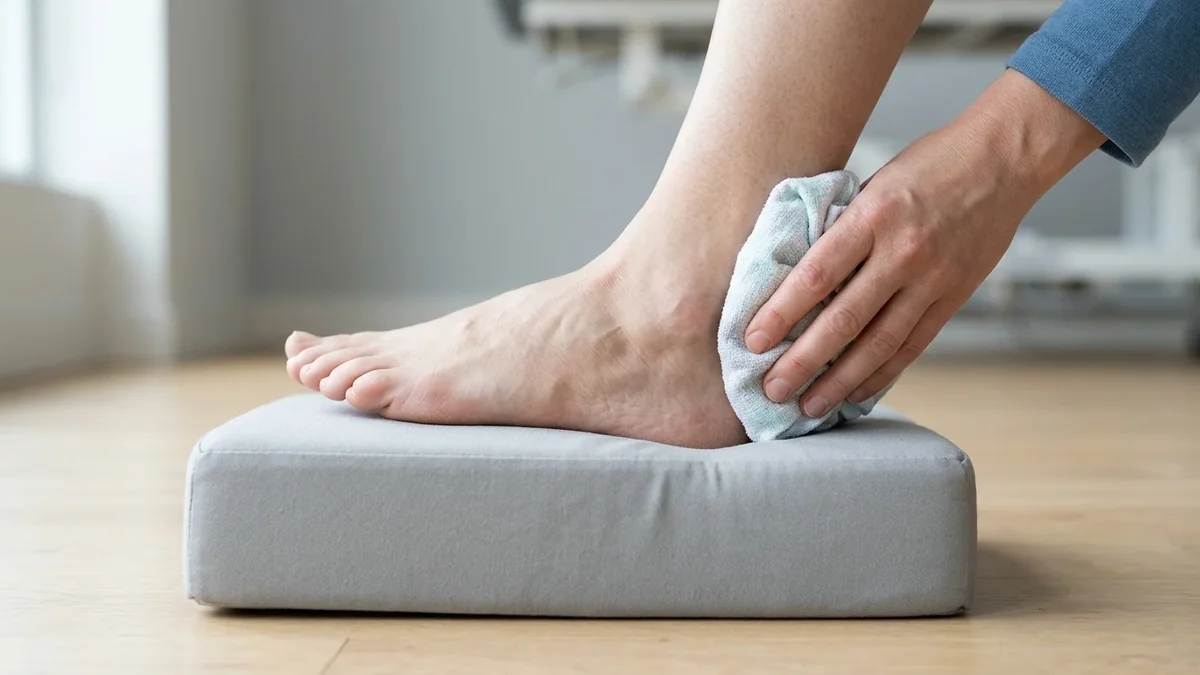
Never put ice straight onto your skin, and take care if you have reduced feeling or poor circulation (MSK Dorset).
A pharmacist can advise on the best painkiller, heel pads and insoles, skin problems such as cracked heels, and whether you need a GP. Stretch your sole before you stand up, and skip going barefoot for the first hour of the day (MSK Dorset).
What to avoid
While your heel is sore, the NHS advises you to avoid:
- long periods of standing or walking, especially barefoot
- wearing high heels or tight, pointed shoes
- flip-flops and backless slippers
- walking barefoot on hard floors
That list also answers a common question about the worst thing to do with plantar fasciitis. Swap high-impact exercise for something easier on your feet, such as swimming.
6 exercises for heel pain
Gentle calf and sole stretches, plus heel raises, are the core exercises NHS services give for pain under the heel. A physiotherapist can turn them into a tailored exercise plan.
How much and how hard?
The exercises may feel uncomfortable, but they should not make your symptoms much worse (Berkshire Healthcare NHS). If they do, take a break and speak to your GP or physiotherapist.
You do not need to avoid pain completely. Extra pain should settle within a few hours; if not, ease off next time (Royal United Hospitals Bath). Keep going for at least 3 to 4 months.
1. Calf stretch against a wall
- Face a wall and rest your hands on it.
- Step the sore leg back, keeping it straight with the heel down. Bend your front knee.
- Lean forwards until you feel a stretch in the calf of the back leg.
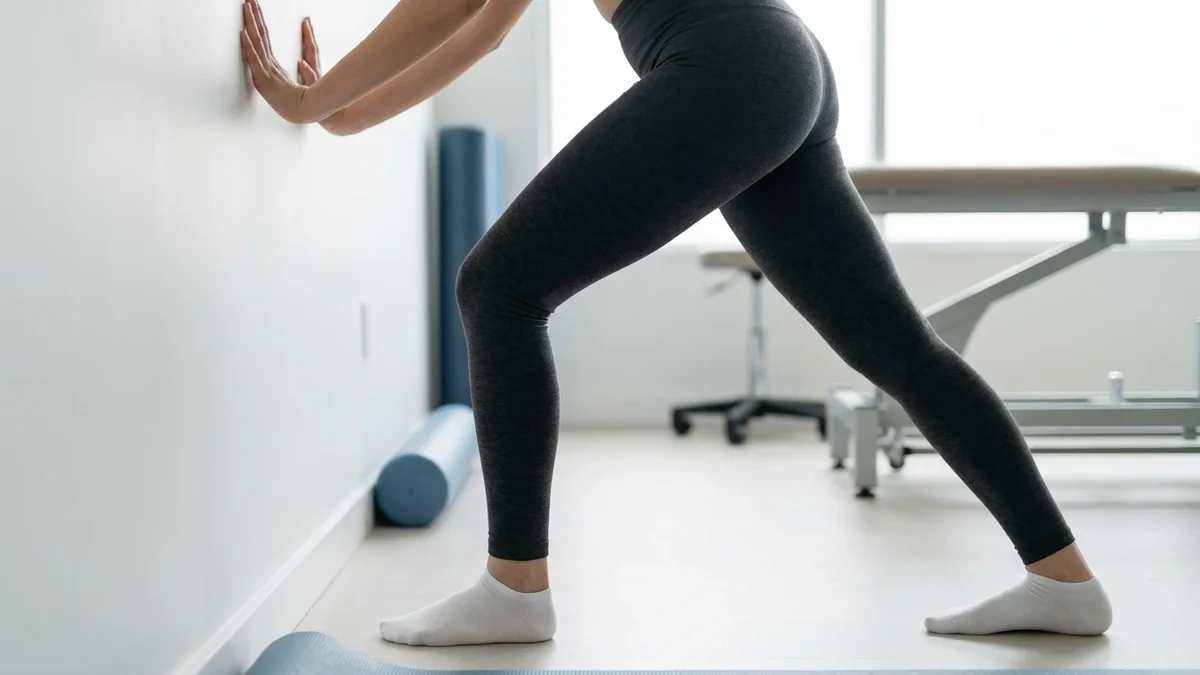
How much: hold for 20 seconds, 3 times (NHS Fife). MSK Dorset adds a version with the back knee bent and the heel down: about 30 seconds, 3 times.
2. Towel stretch
- Sit with your legs out straight in front of you.
- Loop a towel around the ball of your foot and hold both ends.
- Keeping your knee straight, pull the towel towards you until you feel a stretch under your foot and in your calf.
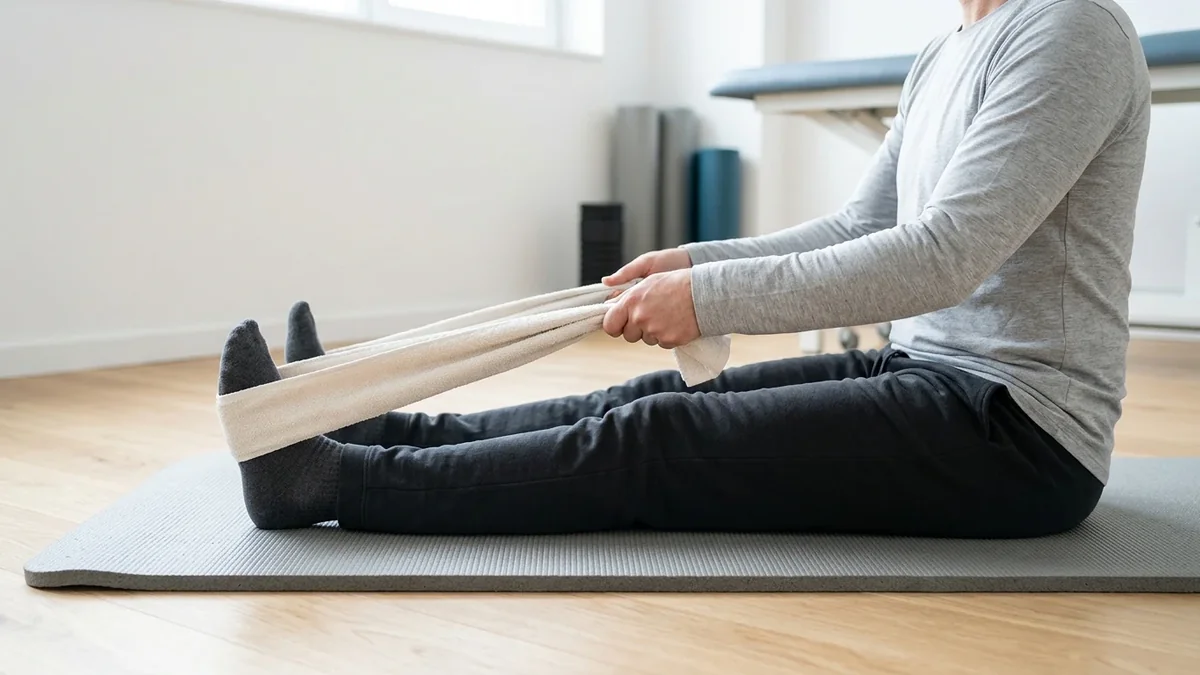
How much: hold for 20 seconds, 3 times (NHS Fife). The Royal National Orthopaedic Hospital suggests doing it before you get out of bed.
3. Sole stretch
- Sit and rest the ankle of your sore foot on your other knee.
- Hold your heel with one hand.
- With the other hand, pull your toes back towards your shin until you feel a stretch along your sole.
How much: hold for 15 to 20 seconds, 3 times, before standing up after sitting or lying down (MSK Dorset).
4. Arch roll
- Sit with your foot resting on a tin of beans or a tennis ball.
- Roll your arch over it, forwards, backwards and side to side, for a few minutes.
How much: at least twice a day (MSK Dorset). For a cooling version, roll a frozen 500ml bottle of water under your foot, with a towel between (NHS Fife).
5. Heel raises
- Stand close to a wall with your hands on it for balance.
- Rise slowly onto your tiptoes.
- Lower your heels back down slowly.
How much: build up over several weeks towards 3 sets of 10 to 15 (NHS Fife).
6. Towel scrunch
- Sit with your foot flat on a small towel on the floor.
- Keeping your heel down, use your toes to scrunch the towel towards you.
- Flatten the towel out and start again.
How much: repeat 3 to 5 times (NHS Fife).
How long does heel pain last?
Getting rid of it takes patience: pain under the heel often lasts months rather than weeks. MSK Dorset says the average episode lasts over 6 months, but about 90% of cases are treated successfully without surgery.
Some people improve within a few weeks of starting exercises; others need much longer (Royal United Hospitals Bath).
| Cause | How long it usually lasts | Source |
|---|---|---|
| Plantar fasciitis | Often over 6 months; most recover within 12 months, but it can take up to 18 | MSK Dorset, RUH Bath, RNOH |
| Fat pad syndrome | Most improve, but it may take several months | NHS Lanarkshire |
| Bursitis | Should go away in a few weeks | NHS |
| Sever’s disease (children) | 3 to 6 months with the right advice; ends when growing stops | NHS Fife, Cambridge University Hospitals |
It can also come back: the Royal Orthopaedic Hospital says having it once makes it more likely again.
Can you run with heel pain?
Ease off first. Wait until you can walk several miles and do your exercises without your heel getting worse, then return to jogging or running (RUH Bath).
RUH Bath suggests limiting the activities that aggravate your heel for about six weeks, then building up over a month or two. Swimming or cycling can keep you fit meanwhile (MSK Dorset).
If you get heel pain after running, check your trainers: MSK Dorset suggests replacing them after about 500 miles. Knees aching too? Read our guide to runner’s knee.
How a physiotherapist treats heel pain
A physiotherapist checks your foot, ankle and calf, finds what is driving the pain and builds a stretching and strengthening plan with you. The NHS says a physio can show you exercises to ease it.
A US physiotherapy guideline supports hands-on treatment, calf and sole stretches, and taping alongside other treatment (JOSPT, 2023). A large review found taping and stretching eased first-step pain in the short term (British Journal of Sports Medicine, 2021).
Taping is included in our appointments, but avoid it if you have sensitive skin or a rash appears (East Sussex Healthcare NHS Trust).
The guideline also supports dry needling of tight spots in the calf and foot muscles to ease pain. We may offer acupuncture or dry needling alongside your exercises, if it suits you.
If your heel does not settle, a GP, podiatrist or specialist may suggest insoles, night splints, shockwave therapy or steroid injections. Surgery is rarely needed (Royal Orthopaedic Hospital). We do not offer these, but your physiotherapist will tell you if you need a GP or a scan.
You can often refer yourself to NHS physiotherapy, but waits can be long, or you can pay privately. Book a physiotherapy assessment for a clear plan.
When to see a GP or get urgent help
When should you be concerned? Most heel problems are not an emergency, but some signs need NHS 111, A&E or a GP (NHS).
Contact NHS 111 if you:
- have severe pain in your heel after an injury
- heard a snap, grinding or popping sound when it happened
- cannot walk, walk on tiptoe or walk up stairs
- notice your foot or ankle has changed shape or sits at an odd angle
- have a swollen, bruised calf and ankle
- feel faint, dizzy or sick because of the pain
These may mean a broken heel bone or ankle, so do not try to treat it yourself.
Go to A&E if it suddenly feels like a hard kick to the calf, with new pain and swelling near the heel. The Achilles tendon may have torn.
See a GP if:
- the pain is severe or stops you doing your normal activities
- it is getting worse or keeps coming back
- it has not improved after 2 weeks of home treatment
- you have tingling or loss of feeling in your foot
- you have diabetes, because foot problems can be more serious
- your heel is red and swollen and you have a high temperature or feel hot, cold or shivery
Sources: NHS and Sherwood Forest Hospitals.
Heel pain FAQs
Why does my heel hurt in the morning?
It is typical of plantar fasciitis, which is often much worse with your first steps after rest (NHS). Stretching your sole before standing can help (MSK Dorset).
Do heel pads or insoles help?
They can. The NHS suggests soft insoles or heel pads for heel pain as part of home care, and a pharmacist can help you choose. If the pain continues, a podiatrist may suggest insoles and suitable shoes.
Will heel pain go away on its own?
Often, yes, but slowly. An NHS podiatry service in North Cumbria says pain under the heel often improves without any treatment. It can take months, so keep up the self-care.
What if I have diabetes and a sore heel?
See a GP. The NHS warns that diabetes can make foot problems more serious. Get advice too for any tingling or loss of feeling in your foot.
Book a heel pain assessment in Birmingham
Most heel pain settles with good shoes, regular stretching and patience. If yours is not improving, Prime Physiotherapy Clinic can check your foot, ankle and calf and build a plan with you.
If you have rolled your ankle, our guide to ankle sprain treatment covers the first weeks of rehab.
Every appointment is £50 for 45 minutes, self-pay, with no GP referral needed, and taping is included. Visit us at Suite 3A, Cobalt Square, 83–85 Hagley Road, Birmingham B16 8QG. We are open Monday to Sunday, 9am to 9pm.
Book your assessment online, call or WhatsApp us on +44 7944 274894, or contact us. We aim to reply within 2 hours during opening hours.