Achilles tendon exercises can be extremely effective, but the right dose matters. The Achilles tendon is strong, spring-like and built to tolerate high loads during walking, running, jumping and sport. When its capacity is exceeded, or when training changes too quickly, pain and stiffness can develop around the back of the heel or lower calf. Many people call this Achilles tendonitis, although persistent cases are often described as Achilles tendinopathy.
The key message is simple: the Achilles usually needs progressive loading to recover, not complete rest forever. However, loading too heavily too soon can keep symptoms irritated. This guide explains common symptoms, safe exercises, load management, return-to-running principles and when physiotherapy can help. If you felt a sudden pop, cannot push off, cannot do a single-leg heel raise or suspect a rupture, seek urgent medical assessment.
What Is Achilles Tendonitis Or Tendinopathy?
The Achilles tendon connects the calf muscles to the heel bone. It stores and releases energy during walking and running, which is why it is placed under significant demand. Achilles tendon pain is often linked to a mismatch between load and capacity. That mismatch can come from a sudden increase in running distance, hill work, speed sessions, jumping, changes in footwear, returning after rest or adding too much gym work too quickly.
In early cases there may be more obvious irritation and morning stiffness. In longer-lasting cases, the tendon can become sensitive and less tolerant of load. Pain does not always mean the tendon is tearing. It often means the tendon is not currently coping with the demands placed on it. Rehab aims to rebuild that capacity.
There are two common locations. Mid-portion Achilles tendinopathy is felt a few centimetres above the heel. Insertional Achilles tendinopathy is felt where the tendon attaches to the heel bone. The location matters because insertional symptoms may be aggravated by deep stretching and heel drops below step level, especially early on.
Common Achilles Tendon Symptoms
- Pain or stiffness at the back of the heel or lower calf.
- Morning stiffness that eases after walking for a few minutes.
- Pain at the start of running that warms up, then returns later.
- Tenderness or thickening around the tendon.
- Pain climbing stairs, walking uphill or pushing off.
- Symptoms after a sudden increase in training load.
A common pattern is pain that feels better once warmed up, which tempts people to keep training. The problem is that symptoms may then flare later that day or the next morning. Morning response is one of the best clues for tendon load tolerance. If stiffness is worse the day after activity, the tendon may not have tolerated the previous load.
When To Get Urgent Help
Seek urgent assessment if you felt a sudden snap or pop, were kicked in the back of the ankle, cannot walk normally, have a visible gap in the tendon, or cannot rise onto the toes on the affected side. These signs may suggest a rupture or more serious injury. Do not try to stretch or strengthen through suspected rupture.
You should also seek medical advice if the area is hot, red and swollen without a clear training cause, if you feel unwell, or if pain is severe and unexplained. Most Achilles pain is mechanical or load-related, but not every painful tendon should be treated with a generic exercise plan.
The First Step: Manage Load
Load management does not mean doing nothing. It means reducing the activities that are currently exceeding tendon capacity while keeping enough activity to maintain fitness and stimulate recovery. For runners, that may mean reducing hills, speed work, long runs or consecutive running days. For gym users, it may mean temporarily reducing jumping, heavy calf raises or sled pushes.
Use the next-morning rule. If an activity causes mild discomfort during exercise but symptoms are no worse the next morning, the dose may be acceptable. If morning stiffness or pain clearly increases, reduce the volume, intensity or frequency. This simple rule prevents many avoidable flares.
Footwear can also influence symptoms. Some people feel better with a temporary heel raise or shoes with a slightly higher heel-to-toe drop because it reduces stretch on the tendon. This is not a permanent fix, but it can help calm symptoms while rehab begins. Barefoot walking, flat shoes and hill walking can be provocative for some cases.
Achilles Tendon Exercises To Start With
The exercises below are general starting points. If you have insertional Achilles pain at the heel bone, avoid dropping the heel below step level early on. If you have mid-portion pain, step-based work may be introduced later if tolerated. Pain during exercise should usually stay mild to moderate and settle by the next day.
1. Seated Calf Raise Isometric
Sit with the feet flat on the floor. Press through the ball of the foot and lift the heel slightly, holding the position for 20 to 30 seconds. Add gentle pressure through your hands on the knee if comfortable. Repeat 4 to 5 times. This can be a useful entry point when standing calf raises are too painful.
Isometric loading can reduce sensitivity for some people and begins the process of tendon loading without large movement. Keep effort moderate and avoid cramping in the calf.
2. Double-Leg Standing Heel Raises
Stand holding a worktop or wall for balance. Rise onto both toes slowly, pause, then lower with control. Start with 2 sets of 8 to 10 repetitions. Keep the weight even through both feet. If that is easy and symptoms are stable the next day, build towards 3 sets of 12 to 15.
This exercise is often the foundation. It teaches the tendon to tolerate repeated load again. Move slowly enough that you are not bouncing. Tendon rehab is not about speed at the start.
3. Slow Single-Leg Heel Raises
Once double-leg heel raises are comfortable, progress to single-leg raises. Hold support for balance. Rise slowly, pause, then lower over three seconds. Start with 5 to 8 repetitions. If you cannot lift through the full range, use partial range or continue double-leg work for longer.
Single-leg strength is important for running because each stride loads one leg at a time. Do not rush this step. Quality matters more than hitting a high repetition number while the ankle wobbles or pain increases.
4. Bent-Knee Calf Raises
Bent-knee calf raises target the soleus muscle, which is heavily involved in running. Stand with knees slightly bent and rise onto the toes while keeping the knees bent. Lower slowly. Start with both legs, then progress to single-leg versions if tolerated.
Many runners focus only on straight-knee calf work. Soleus strength is often essential for return to running because it manages repeated ground contact. A complete plan usually includes both straight-knee and bent-knee loading.
5. Eccentric Heel Drops
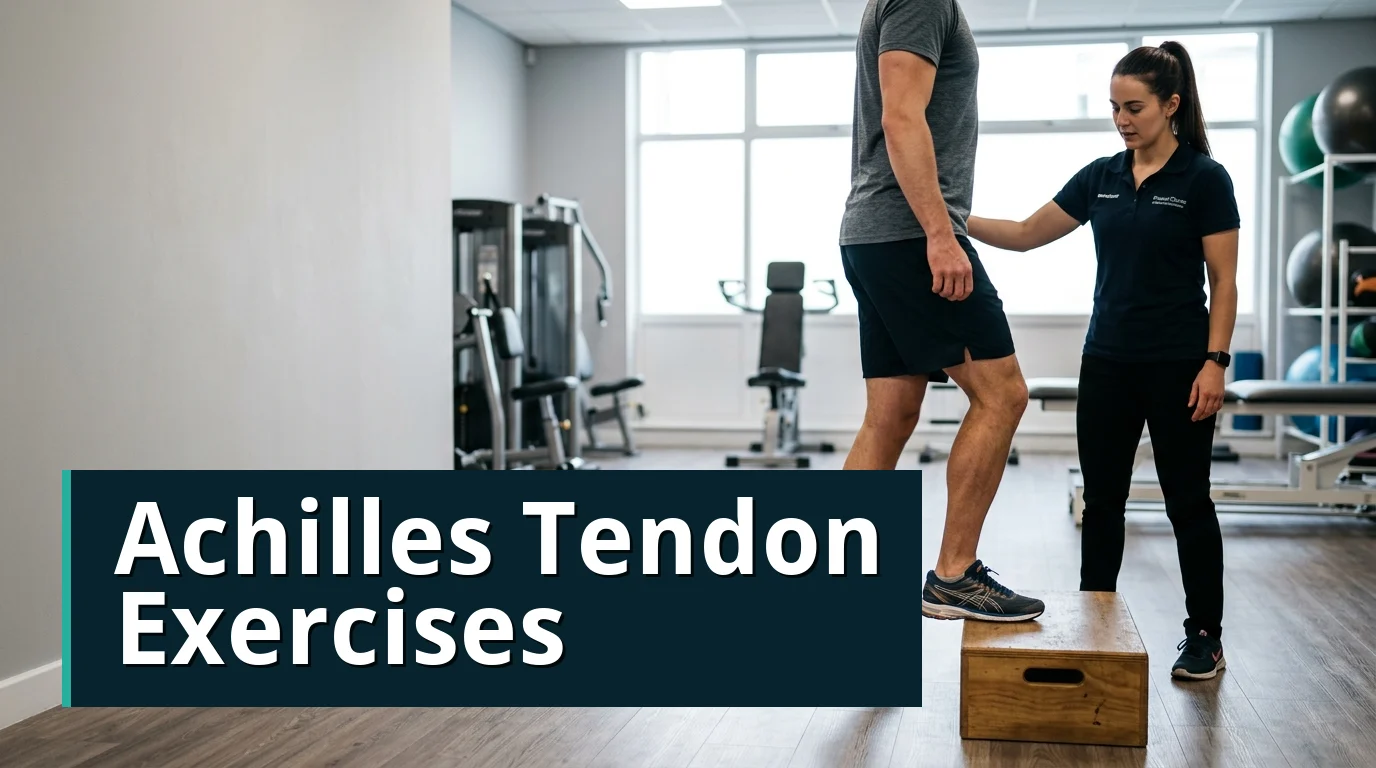
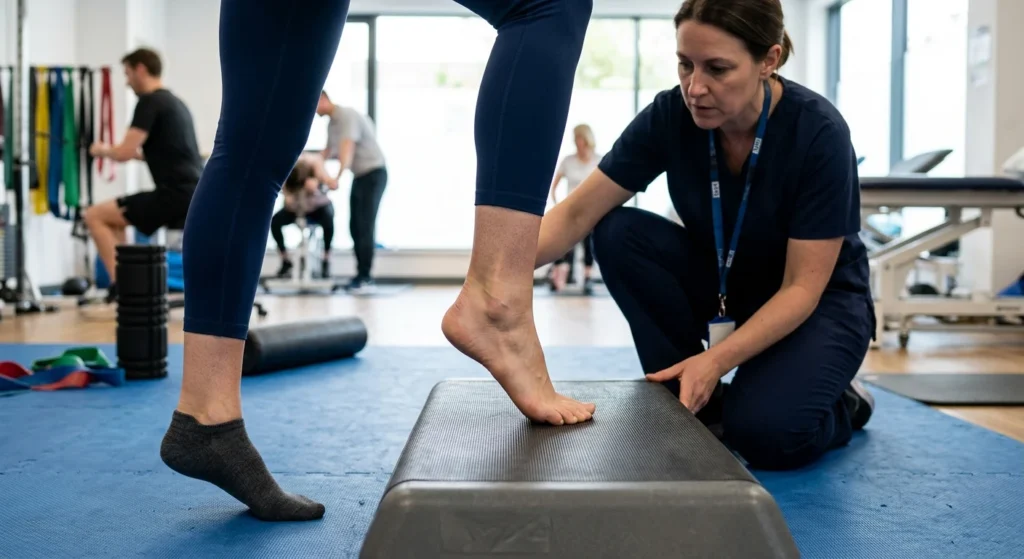
Eccentric heel drops are well-known for Achilles tendinopathy, but they are not the right first exercise for everyone. For mid-portion symptoms, stand on a step, rise with both feet and lower slowly on the affected side. For insertional symptoms, avoid dropping below neutral early on because compression at the heel can aggravate pain.
If you use heel drops, introduce them carefully. Start with low volume and track next-morning response. More is not always better. If a classic protocol causes repeated flares, it needs adapting.
6. Balance And Foot Control
Stand on one leg for 20 to 30 seconds near support. Keep the foot tripod active: big toe base, little toe base and heel. Progress by turning the head, reaching the free leg or standing on a slightly softer surface. Balance work helps the foot, calf and hip coordinate load.
Should You Stretch The Achilles?
Stretching depends on the type of Achilles pain. If symptoms are insertional at the heel, strong calf stretching can compress the tendon at its attachment and make symptoms worse. If symptoms are mid-portion and the calf is genuinely stiff, gentle stretching may help, but it should not be the main treatment.
Most Achilles rehab should prioritise progressive strengthening and load management. Stretching can be used carefully if it improves comfort and does not worsen morning symptoms. If stretching feels good for five minutes but symptoms are worse tomorrow, it is not the right dose.
Return To Running
Return to running should be gradual. Before running, you should usually be able to walk briskly, climb stairs and perform calf raises with manageable symptoms. You do not need to be completely pain-free, but symptoms should be stable and predictable.
Start with run-walk intervals on flat ground. For example, run one minute, walk one minute, repeat 8 to 10 times. Review symptoms during the run, later that day and the next morning. If the tendon responds well, increase total running time slowly. Avoid adding speed, hills and distance all in the same week.
Runners often flare because fitness returns faster than tendon capacity. You may feel aerobically ready for more, but the tendon needs time to adapt. Keep strength work in the programme even when running restarts. It is part of the return-to-running plan, not a separate optional extra.
What To Avoid With Achilles Tendon Pain
- Avoid sudden increases in running distance, hills or speed.
- Avoid repeated jumping or sprinting during a flare.
- Avoid deep heel drops if insertional heel pain is aggravated by compression.
- Avoid complete rest for weeks without rebuilding strength.
- Avoid judging progress only by pain during activity; check the next morning too.
It is also worth avoiding panic. Tendon pain can be stubborn, but it often responds well to a clear plan. The frustrating part is that the plan may need to continue for months, not days. Consistency beats intensity.
The same rules help if the pain is at the front of your knee instead: our guide to runner’s knee explains the exercises and how long recovery usually takes.
How Physiotherapy Helps Achilles Tendonitis
Physiotherapy helps by identifying the load problem and building a plan that matches your goal. A runner training for a half marathon, a footballer returning to matches and someone who simply wants to walk comfortably may all need different progressions. Assessment may include calf strength, ankle range, foot control, hip strength, training history and footwear discussion.
Treatment may include progressive strengthening, return-to-running planning, manual therapy for related stiffness, advice on temporary load modification and education on symptom monitoring. At Prime Physiotherapy Clinic, Achilles rehab can link with sports injury treatment and exercise prescription depending on your needs.
A Simple Weekly Rehab Plan
Use this only if symptoms are mild to moderate and there are no rupture signs. Start with a level that feels manageable. If the next morning is worse, reduce the dose. If symptoms stay stable for one to two weeks, progress gradually.
- Three days per week: calf strengthening using seated or standing heel raises.
- Two days per week: balance and foot control drills.
- Daily: normal walking within tolerance.
- Running: only if walking and calf raises are tolerated, starting with run-walk intervals.
- Review: track morning stiffness, pain location and activity response.
Mid-Portion vs Insertional Achilles Pain
Knowing where your symptoms sit can change the exercise plan. Mid-portion Achilles pain is usually felt a few centimetres above the heel. It often responds well to progressive calf strengthening and may later tolerate heel drops from a step. Insertional Achilles pain is felt right where the tendon meets the heel bone. This type can be more sensitive to compression when the ankle is pushed into deep dorsiflexion.
If your pain is insertional, avoid aggressive calf stretching and deep heel drops below step level in the early stage. Use flat-ground heel raises, shoes with a comfortable heel height and gradual strengthening. If your pain is mid-portion, you may still start on flat ground, but step-based work can be added later if the next-morning response is stable.
How To Build Calf Strength Properly
Achilles rehab should eventually become heavy enough to create adaptation. Early exercises may be light because symptoms are irritable, but a runner or active adult usually needs more than gentle movements forever. Once double-leg and single-leg heel raises are tolerated, loading can progress with a backpack, dumbbells or gym machines.
A complete programme should include both straight-knee and bent-knee calf work. Straight-knee work targets the gastrocnemius more, while bent-knee work loads the soleus. The soleus is especially important for running because it manages repeated ground contact. Many stubborn Achilles cases improve when soleus strength is trained consistently rather than ignored.
Tempo matters. Slow, controlled repetitions usually work better in early rehab than bouncing. A simple starting tempo is two seconds up, one second pause and three seconds down. Later, the plan may include faster calf work and hopping, but only after strength and symptoms are ready.
Return To Hills, Speed And Sport
Flat run-walk intervals are usually easier on the Achilles than hills and speed work. Hills increase calf and tendon demand, especially uphill running. Speed work increases force and stiffness demands. Introduce these only after flat running is stable for several weeks and morning stiffness is not increasing.
A sensible sequence is flat walking, brisk walking, run-walk intervals, continuous easy running, slightly longer easy runs, then gentle hills or speed. Do not add hills, speed and distance in the same week. If you play football, tennis or netball, add change of direction and jumping gradually before full match intensity.
Common Mistakes With Achilles Tendon Rehab
The first mistake is relying on rest alone. Rest may reduce pain, but the tendon often loses more capacity. When running or sport returns, symptoms come back because the tendon has not been rebuilt. The second mistake is doing a famous heel-drop protocol without adapting it to pain location. Insertional pain often dislikes deep heel drops early on.
The third mistake is ignoring the next morning. Achilles symptoms can feel acceptable during activity and then complain the next day. Morning stiffness is one of the most useful load monitors. The fourth mistake is stopping rehab once pain reduces. Tendon capacity needs to exceed your goal, not merely match a quiet week. Keep strengthening as running or sport returns.
When Footwear Or Orthotics May Help
Footwear changes can help manage symptoms while rehab does the deeper work. A shoe with a slightly higher heel-to-toe drop may reduce tendon stretch for some people. A temporary heel raise can also help during painful walking phases. This does not mean you must wear one forever. It is a way to reduce irritation while strength is rebuilt.
Orthotics may be useful for some people, especially if foot mechanics, comfort or training load are contributing. They are not a universal answer. If you are repeatedly buying new shoes or supports without improving strength and training load, the main problem may still be unaddressed. A physiotherapy assessment can help decide whether footwear advice is enough or whether a fuller rehab plan is needed.
How To Test Readiness For Running
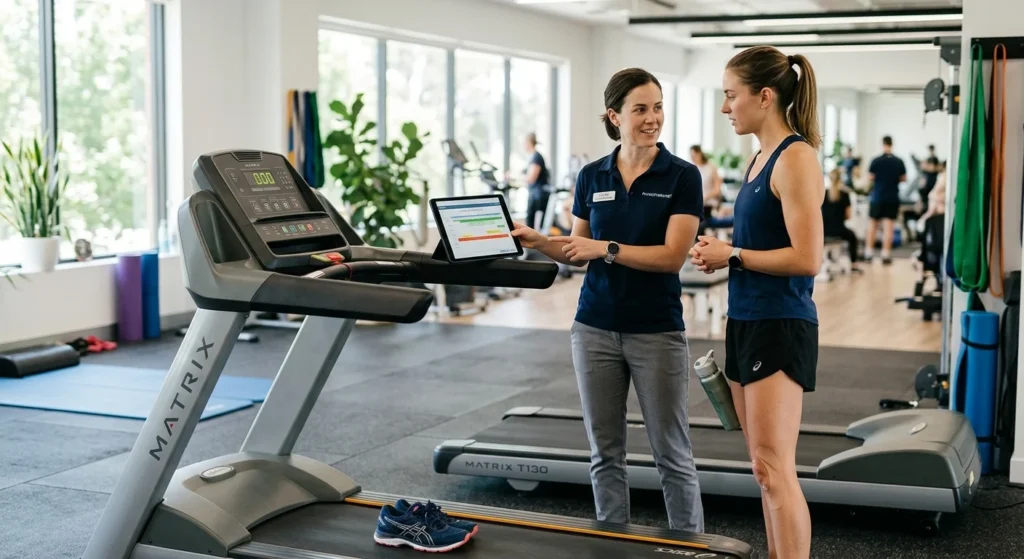
Before running, test the building blocks. Can you walk briskly for 30 minutes without a next-day flare? Can you perform repeated double-leg heel raises and controlled single-leg heel raises? Can you balance on one leg and do small hops without sharp pain? These tests do not guarantee success, but they reduce guesswork.
Once these markers are acceptable, start with flat run-walk intervals and keep the first session deliberately easy. The goal is to see how the tendon responds, not to regain fitness in one session. If morning stiffness increases, step back. If the response is calm, progress slowly. Achilles rehab often fails when the cardiovascular system is ready for more before the tendon is.
Strength Benchmarks To Aim For
Useful benchmarks depend on your goal. A casual walker may need enough strength for stairs, hills and longer days out. A runner needs stronger calf capacity, repeated single-leg control and eventually plyometric tolerance. A field-sport athlete needs acceleration, deceleration, jumping and change of direction. Your rehab should become specific to the activity you want back.
A common target for runners is being able to perform controlled single-leg heel raises with good height and endurance on both sides. Some people also need heavier loaded calf raises in the gym. These should be introduced carefully, but they matter because running loads are high. Gentle exercises alone may not prepare the tendon for sport.
Managing Flare-Ups During Rehab
A flare-up does not mean rehab has failed. It usually means the dose exceeded current capacity. Reduce the most provocative activity for a few days, return to a tolerable strengthening level and use the next-morning rule. Avoid stopping everything unless symptoms are severe. The tendon still needs load, but it may need a smaller dose.
If flare-ups keep happening despite careful progression, the plan needs review. Common missing factors include too much hill work, inadequate soleus strengthening, poor recovery between runs, sudden footwear changes, or progressing plyometrics too early. A sports physiotherapy assessment can help identify the specific limiter.
Think of Achilles recovery as rebuilding a training base for the tendon. Pain reduction is useful, but capacity is the real goal. When calf strength, running tolerance, hopping control and next-morning symptoms all improve together, you are building a stronger foundation for long-term return to activity.
FAQs About Achilles Tendon Exercises
What is the best exercise for Achilles tendonitis?
Heel raises are a common foundation, but the best version depends on symptoms. Some people start with seated or double-leg raises, then progress to single-leg, bent-knee and heavier loading.
Should I run with Achilles pain?
You may be able to run with mild, stable symptoms, but avoid running if pain is worsening, changing your gait or clearly worse the next morning. A graded return-to-running plan is safest.
Are heel drops safe?
Heel drops can help some mid-portion Achilles cases, but they can irritate insertional pain at the heel if done below step level. Exercise choice should match pain location and response.
When should I see a sports physio?
See a physiotherapist if pain persists, keeps returning, limits running or sport, or if you are unsure how to progress. Seek urgent help for suspected rupture or sudden severe symptoms.
Book Achilles Tendon Rehab Support
If Achilles pain is stopping you running, training or walking comfortably, a structured plan can help you rebuild capacity. Prime Physiotherapy Clinic can assess your tendon, calf strength, running goals and training load, then guide you through progressive rehab. You can book online or explore our sports injury treatment service.