
Is a sharp, burning or tingling pain spreading across your shoulder or shoulder blade, maybe down your arm? People call it a trapped or pinched nerve. It can be very painful, but most people’s symptoms improve over time.
This trapped nerve in shoulder guide explains where the pain comes from, how to ease it and 6 gentle exercises with NHS doses. It also covers sleep, recovery time and when to get help.
Not sure what is causing your pain? A physiotherapy assessment can find out.
Key takeaways
- It usually starts with an irritated nerve in your neck.
- Keep moving gently, because long rest does not help.
- NHS inform says it usually starts to improve within 12 weeks.
- Call 999 for chest pain spreading to your arm. Get urgent advice for arm weakness or clumsy hands.
What is a trapped nerve in the shoulder?
A trapped nerve in the shoulder usually means a nerve in your neck has become irritated. The medical name is cervical radiculopathy. The nerves that supply your shoulders, arms and hands leave the spine in your neck, so the pain shows up there.
It is common and usually affects one side. NHS Fife says it is not usually serious. A pinched nerve is the same problem by another name.
“Trapped” is a misleading word, though. NHS physiotherapists in Norfolk and Waveney explain that nerves don’t get trapped: they get irritated, like any other body tissue, and are generally quite resilient.
Trapped nerve, shoulder impingement or frozen shoulder?
Shoulder pain is not always a nerve. Where it hurts gives a clue, and a physiotherapist can tell these apart.
| Problem | Where it hurts | What makes it worse | Other signs |
|---|---|---|---|
| Trapped nerve (from the neck) | Neck, shoulder blade and down the arm, sometimes into the fingers | Poor sleep and stress can affect it | Pins and needles, numbness, burning pain or weakness, usually on one side |
| Shoulder impingement | Top and outside of the shoulder | Lifting your arm, especially above your head | Can be worse at night; arm weakness |
| Frozen shoulder | The shoulder joint | Moving the shoulder | Stiffness for months, sometimes years; pain can be worse at night |
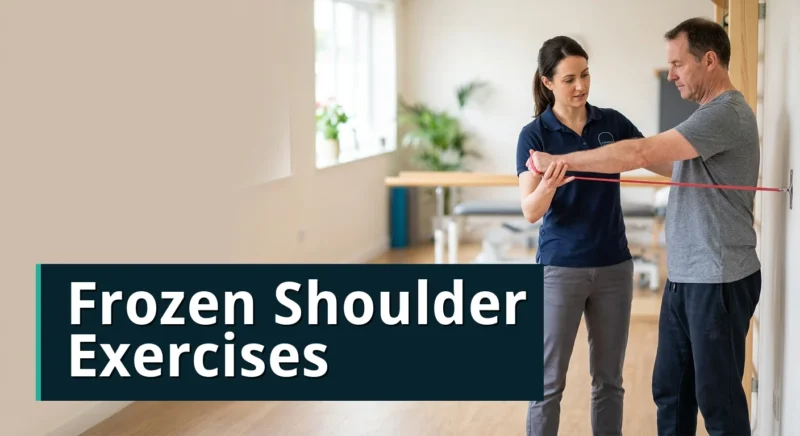
If stiffness is your main problem, our guide to frozen shoulder exercises may help.
Trapped nerve in shoulder symptoms
The main symptom is pain that spreads from your neck or shoulder into your arm. NHS inform, NHS Fife and NHS Lanarkshire list these common symptoms of a pinched nerve in the shoulder:
- pain in your arm, often with neck pain
- pain in your shoulder blade
- pins and needles or numbness in your arm or hand
- a burning pain that can reach your fingers
- weakness or a heavy feeling in your arm or hand
- headaches, sometimes
It usually affects one side, and symptoms can come and go.
Trapped nerve in the shoulder blade
Pain in, beside or behind your shoulder blade is a common sign of an irritated neck nerve. NHS Fife lists it among the usual symptoms. Searches for a “pinched nerve in shoulder blade” or “trapped nerve in shoulder blade” usually describe this same problem.
Some shoulder blade pain needs urgent checks, though. For neck pain from cervical spondylosis, the NHS lists pain between your shoulder blades as a reason for urgent advice.
Take left-sided pain seriously too. Call 999 for chest pain that feels tight or squeezing, or spreads to your arms, neck or jaw: these are signs of a heart attack.
What causes a trapped nerve in the shoulder?
The nerve is usually irritated where it leaves your neck. NHS inform lists inflammation around the nerves, a neck injury and age-related changes to the discs, ligaments or joints in your neck.
A disc can bulge with age, repetitive movements or injury and occasionally press on a nerve, says NHS Fife. Symptoms can also start for no clear reason, according to MSK Dorset.
The NHS lists sitting at a desk for a long time as a cause of neck pain. Poor sleep and stress can affect symptoms (NHS inform). Smoking makes nerves more sensitive and can slow recovery, says NHS Fife.
If you work at a computer, our forward head posture guide has tips for long spells at a desk.
How to release a trapped nerve in the shoulder
You can’t “release” a nerve like a tight muscle, because it is irritated rather than caught. There is no quick fix, but you can treat it at home and relieve the pain with these NHS steps:
- Keep moving. Move a little and often, and avoid staying in one position for long.
- Pace yourself. Break tasks into smaller chunks and build up gradually.
- Don’t rest for long. A few days’ rest may help early on, but long rest does not (NHS Fife).
- Use pain relief to keep moving. MSK Dorset says paracetamol works best taken regularly. Ibuprofen can ease swelling, but check with a pharmacist and avoid it for 48 hours after an injury. A doctor can prescribe nerve pain medicine.
- Try heat or cold. The NHS suggests heat or cold packs on your neck.
- Keep working if you can. NHS inform says work helps your recovery, and you don’t need to be free of symptoms first.
MSK Dorset says people who use pain relief to keep moving recover quicker than those who hold themselves stiff.

6 exercises for a trapped nerve in the shoulder
Gentle neck stretches and shoulder blade movements, done little and often, help the nerve settle. These exercises and doses come from NHS physiotherapy services.
How much and how hard?
NHS inform’s pain guide rates exercise pain out of 10:
- 0 to 3: minimal pain
- 4 to 5: acceptable pain
- 6 to 10: too much, so make the exercise easier
Above 5, do fewer repetitions, move more slowly or rest longer. Your pain should be no worse the next morning. Stop if an exercise makes your symptoms worse or causes new pain.
Start with 2 to 3 repetitions at a time, a few times a day, such as every hour. As it gets easier, add 1 or 2 every few days, up to around 10.
1. Chin tuck
- Sit upright.
- Pull your chin in, keeping your neck and back straight, without tipping your head forwards.
- Hold where you feel a stretch, then relax.
How much: little and often. If sitting hurts, start lying on your back with your head on a pillow (MSK Dorset).
2. Head turn
- Sit, or lie on your back, facing forwards.
- Slowly turn your head to one side as far as is comfortable.
- Hold for 2 seconds, come back, then turn the other way.
How much: one turn each way is one repetition (NHS inform).
3. Head tilt
- Sit, or lie on your back, facing forwards.
- Slowly tilt your head towards one shoulder until you feel a stretch on the other side of your neck.
- Hold for 2 seconds, come back, then tilt the other way.
How much: one tilt each way is one repetition (NHS inform).
4. Chin down and up
- Face forwards.
- Bring your chin down towards your chest.
- Slowly bring it back up.
How much: down and up again is one repetition (NHS inform).
5. Shoulder blade squeeze
- Sit upright.
- Move your shoulder blades gently back and down, keeping it a small movement.
- Hold for about 5 to 10 seconds, then relax.
How much: one set of 5 to 10, once a day on most days (NHS Fife).

6. Arm turn-out
- Bend your elbows to a right angle in front of you, palms up.
- Keeping your upper arms still, move your forearms out to the sides.
- Hold for a few seconds, then bring them back.
How much: out and in again is one repetition (NHS inform).
A physiotherapist may also teach nerve glides, movements aimed at the nerves themselves. A 2017 research review found they eased long-lasting neck and arm pain, though the evidence is limited.
If symptoms increase, move less far and do fewer repetitions; NHS Fife says you may need to pause for 24 to 48 hours. A physiotherapist can set a tailored exercise programme, and our neck exercises for desk workers help with general stiffness.
How to sleep with a trapped nerve in your shoulder
Lie on your back or on your pain-free side, with your sore arm resting on a pillow. Use a low, firm pillow under your head. These tips suit shoulder blade pain too:
- Rest your sore arm on one or two pillows, which NHS Fife says can ease a heavy arm.
- Adjust the pillow height until you are comfortable.
- Keep your head level with your body, and don’t sleep on your front (NHS).
- In a chair, a firm, straight-backed seat may be better than a soft, low armchair, with a pillow across your lap for your arm.
Contact your GP if your pain is worse at night, says NHS Fife.

How long does a trapped nerve in the shoulder last?
Many people improve within weeks. NHS inform says it usually starts to improve within 12 weeks. Symptoms can take up to a year to settle, and they can come and go.
| When | What NHS guidance says | Source |
|---|---|---|
| First few weeks | The biggest change in symptoms usually comes now | NHS inform |
| 4 to 6 weeks | 75% of people see some improvement; get advice if you haven’t | NHS Fife |
| 6 weeks | Half of people recover on their own; talk to a professional if you haven’t improved | NHS Scotland Right Decisions; NHS inform |
| 12 weeks | It usually starts to improve by now | NHS inform |
| Up to a year | Symptoms can take this long to settle and can come and go | NHS inform |
When to see a physiotherapist or get urgent help
Get urgent help for the warning signs below. Otherwise, NHS inform advises seeing a healthcare professional, such as a physiotherapist, if you haven’t improved within 6 weeks or are getting worse.
Call 999 if you have:
- chest pain that feels tight or squeezing, or spreads to your arms, neck or jaw
- new problems walking
- loss of bladder or bowel control
- a sudden lack of co-ordination, such as trouble buttoning a shirt
Ask for an urgent GP appointment, or contact NHS 111, if you have:
- severe neck pain that starts suddenly or gets worse quickly
- heaviness or weakness in your arms or legs
- pins and needles in an arm as well as neck or arm pain
- pain between your shoulder blades
- clumsy hands, such as dropping things or struggling with buttons or zips
- numbness around your bottom or genitals
- neck pain with a severe headache
Sources: NHS and NHS inform.
Most adults in England can refer themselves to NHS physiotherapy, or you can book privately.
At Prime Physiotherapy Clinic, your physio asks about your symptoms and checks your neck and arm movement and strength. NHS inform says scans are usually not needed.
Treating it combines exercise, advice and hands-on treatment, as NHS Lanarkshire describes for neck pain. It adds that acupuncture may be used alongside exercise for a short time, but it isn’t suitable for everyone.
If arm pain stays severe, a specialist may consider a scan, an injection or, in the most severe cases, surgery (MSK Dorset). If you need a scan or a doctor’s opinion, your physiotherapist will explain why and advise you to see your GP. Book a physiotherapy assessment for a clear plan.
Trapped nerve in shoulder FAQs
Will a trapped nerve in the shoulder go away on its own?
Usually, yes. Half of people recover on their own within 6 weeks, says NHS Scotland’s Right Decisions. NHS inform says it usually starts to improve within 12 weeks, and gentle movement helps.
Can a trapped nerve in the shoulder cause arm numbness?
Yes. An irritated nerve in your neck can cause pins and needles, numbness or weakness in your arm or hand, says NHS inform. Get urgent advice if numbness comes with weakness, clumsy hands or problems walking.
Can a trapped nerve cause neck and shoulder pain?
Yes. NHS Fife lists neck pain, shoulder blade pain and pain spreading into the arm as common symptoms of nerve root pain from the neck.
Can you get a trapped nerve in your shoulder?
You can feel one there, but the irritated nerve usually sits in your neck. NHS Fife says the nerves that supply your shoulders, arms and hands come from the neck. A physiotherapist checks your neck and arm to find the source.
Book a trapped nerve assessment in Birmingham
Most trapped nerve in shoulder problems settle with gentle movement, the right exercises and some patience. If yours is not getting better, Prime Physiotherapy Clinic can assess it and build your plan.
Every appointment is £50 for 45 minutes, self-pay, with no GP referral needed. Visit us at Suite 3A, Cobalt Square, 83–85 Hagley Road, Birmingham B16 8QG. We are open Monday to Sunday, 9am to 9pm.
Book your assessment online, call or WhatsApp us on +44 7944 274894, or contact us. We aim to reply within 2 hours during opening hours.