Does the top and outside of your shoulder ache when you reach up, put on a coat or lie on that side? A rotator cuff injury is one of the most common causes, and most get better without surgery.
This guide covers symptoms, self-care, 6 NHS exercises and recovery times, each linked to its source.
Not sure what is causing your pain? A physiotherapy assessment can help you find out.
Key takeaways
- Most rotator cuff problems get better without surgery, and exercise is the main treatment.
- Keep your shoulder moving, but ease off overhead and behind-the-back movements for a while.
- With regular exercises, most people start to feel better within 6 to 12 weeks.
- Get urgent advice if you can’t move your arm, especially after a fall or injury.
What is a rotator cuff injury?
Your rotator cuff is made up of four muscles. Their tendons link your shoulder blade to your upper arm and keep the ball of the joint in its socket. A rotator cuff injury means these tendons are irritated, overloaded or torn.
The muscles are the supraspinatus, infraspinatus, teres minor and subscapularis, as MSK Dorset explains. NHS Scotland’s Right Decisions says rotator cuff problems cause up to 70% of the shoulder pain seen in GP practices.
Tendon pain is the most common type, and the other is a tear in a tendon. NHS services now call tendon pain rotator cuff related shoulder pain or tendinopathy. Older names include impingement, rotator cuff tendinitis and bursitis.
Rotator cuff injury symptoms
The usual location of pain is the top and outside of your shoulder and upper arm. It is usually worse when you lift your arm away from your body or reach behind your back. MSK Dorset and Sherwood Forest Hospitals also list:
- pain spreading down your arm, or up towards your neck and shoulder blade
- trouble combing your hair, getting dressed or reaching for a seatbelt
- night pain that can affect your sleep, especially lying on the sore side
- at times, a weak arm, less movement, or clicking and catching
Pain may start suddenly, as is common with a tear, or gradually (NHS inform rotator cuff leaflet).
Signs it could be a tear
A tear is more likely if your arm feels weak, not just sore. NHS Tayside’s guide for GPs lists weakness that isn’t caused by pain, night pain that costs you sleep, and crackling when you move.
A sudden tear after an injury in a younger adult needs an urgent specialist assessment, says Right Decisions. Yet many tears cause no pain. Frimley Health says a third of over-65s show some wear and tear on MRI, mostly without symptoms.
How do you know it’s your rotator cuff?
Several shoulder problems feel alike. A physiotherapist can tell which it is by examining you.
| Problem | Where it’s felt | Typical signs |
|---|---|---|
| Rotator cuff tendon pain | Top and outside of the shoulder | Hurts to lift your arm, especially overhead; moves normally when someone else lifts it |
| Rotator cuff tear | Outside and upper arm | Weakness not caused by pain; crackling; may follow a fall |
| Frozen shoulder | The shoulder joint | Painful and stiff for months, sometimes years |
| Trapped nerve (from the neck) | Arm or hand, sometimes the neck | Pins and needles, numbness, tingling or weakness |
Tingling or numbness can come from a nerve in your neck: see our guide to a trapped nerve in the shoulder. If stiffness is the main problem, try our frozen shoulder exercises.
What causes rotator cuff problems?
Often it is age-related change in the tendons. Doing much more than your shoulder is used to, repeated movements or a single injury can also cause it.
- An injury: a sudden awkward movement, a fall on to your arm, lifting or throwing
- Repeated strain or overuse: especially above your head, such as decorating, or heavy gym work
- Linked factors: diabetes, high cholesterol, obesity, poor sleep, stress, smoking and long-term drinking above safe limits
Sources: NHS inform, Right Decisions and the Robert Jones and Agnes Hunt Orthopaedic Hospital (RJAH).
Rotator cuff injury test: how your shoulder is checked
Diagnosis is usually done with a hands-on exam, not a scan. To diagnose it, a physiotherapist or GP asks about your symptoms, then checks how your shoulder moves and how strong it is.
Typical findings are pain lifting your arm yourself, a painful arc partway up and pain pushing against resistance. When the clinician moves your arm for you, it usually moves normally (Right Decisions).
Scans are not usually needed at first. An X-ray shows bones and an ultrasound shows tendons, but a tear on a scan isn’t always what hurts (Sherwood Forest Hospitals).
Our clinic doesn’t arrange scans. If one may help, your physiotherapist explains why and advises you to see your GP.
Rotator cuff injury treatment: what helps first
Treatment of rotator cuff injuries usually starts with things you can do yourself. Keep your shoulder moving, ease off the movements that hurt and start gentle exercises early.
- Keep moving: the NHS says completely stopping using your shoulder can stop it getting better.
- Relative rest: do fewer overhead and behind-the-back movements for a while (MSK Dorset).
- Painkillers: RJAH says paracetamol and ibuprofen work best; MSK Dorset advises no ibuprofen for 48 hours after an injury.
- Ice or heat: wrap an ice pack or hot water bottle in a tea towel. Use it for up to 20 minutes, 2 to 3 times a day (NHS).
- Avoid for now: swimming, tennis and other repeated overhead lifting, strenuous home-made workouts and heavy gym equipment.
There’s no quick cure: the NHS says you usually need to do these things for 2 weeks before the pain starts to ease. About 80% of people get better without surgery, and physiotherapy is normally the only treatment needed (Sherwood Forest Hospitals).
What about taping? A Cochrane review found kinesiology tape gave little or no benefit, though the evidence was weak.
How to relieve rotator cuff pain at night
Pillows are a simple way to support your sore arm so it can’t drop across your body. Oxford University Hospitals suggests these positions:
- On your back: a folded towel or pillow under your upper arm.
- On your good side: a pillow or two in front of you to rest the sore arm on.
- Sitting up: your arm propped on a cushion.
RJAH also suggests taking your pain relief an hour before bed.
Injections and surgery: GP and specialist routes
If pain stays bad despite exercise, a GP or specialist may discuss a steroid injection or, less often, surgery. Our clinic doesn’t offer either.
Sherwood Forest Hospitals says injections are only offered alongside physiotherapy, more than two isn’t recommended, and surgery is rarely needed. A Cochrane review found decompression surgery worked no better than placebo surgery.
Another review found repairing mostly small, age-related tears may add little over non-surgical care. A torn rotator cuff can still improve without surgery. Oxford University Hospitals says exercises can reduce pain and improve movement, even though the tear remains.
6 exercises for a rotator cuff injury
Start small and often. A little extra pain is fine if it settles within 30 minutes and isn’t worse the next day, says RJAH.
NHS inform suggests keeping pain between 0 and 5 out of 10, and stopping if exercises cause new or worse pain. Start with 2 to 3 repetitions, little and often, adding 1 or 2 every few days. Later, try sets of 8 with a minute’s rest, up to 2 sets of 15.
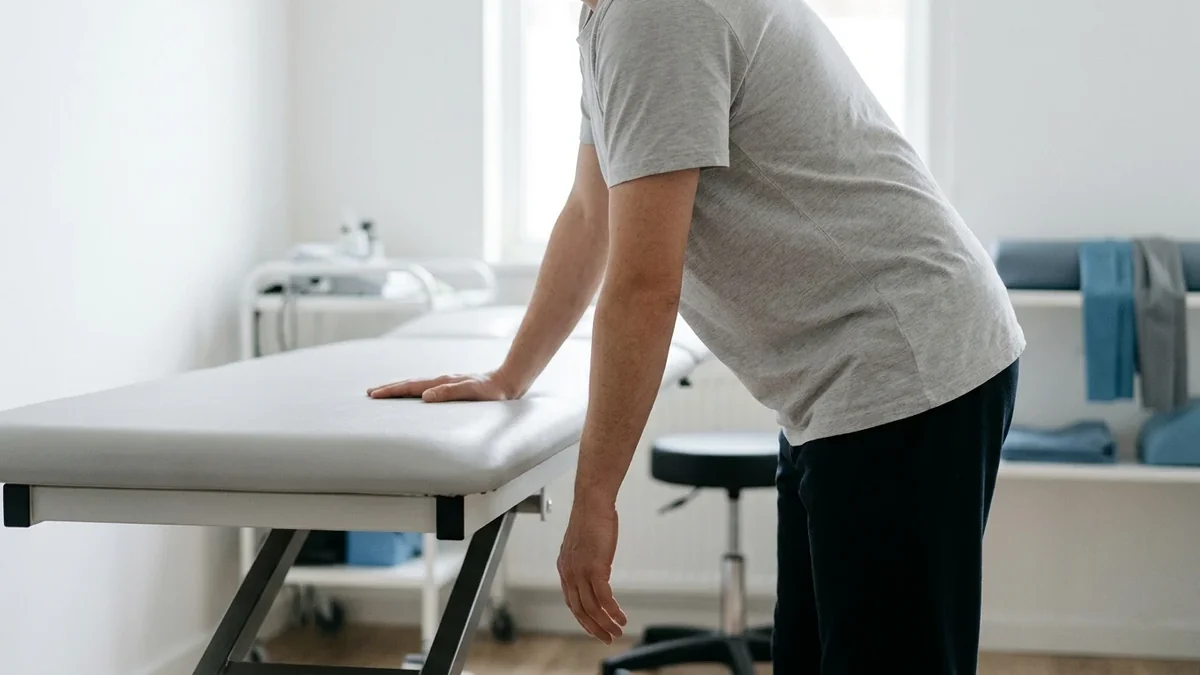
1. Pendulum swings
- Rest one hand on a table and lean forward so your sore arm hangs down.
- Slowly swing it forwards and backwards, then side to side and in small circles.
How much: 2 to 3 swings at first, making them gradually bigger (NHS inform).
2. Wall press outwards
- Stand beside a wall with your elbow bent and tucked into your side.
- Push the back of your hand and wrist into the wall for 5 seconds, then relax.
How much: 5 to 10 times (Sherwood Forest Hospitals).
3. Wall slides
- Face a smooth wall with the edges of your hands on a cloth, thumbs towards you.
- Step forward, gently push into the wall and slide your hands up as far as you can.
How much: 8 times, rest a minute, 3 sets (RJAH).
4. Shoulder rotation with a light weight
- Sit or stand tall with your elbow tucked in at your side.
- Turn your forearm out to the side, then back.
How much: when it’s easy, hold half a kilo or a 500 ml water bottle, building slowly to 2 kg (RJAH).
5. Resistance band rotation, lying down
- Lie on your back, knees bent, with a folded towel under your sore upper arm.
- Bend both elbows to right angles, holding one end of the band in each hand.
- Move the hand on your sore side out to the side, then control it back.
How much: 5 times (Oxford University Hospitals).
6. Wall push-ups
- Put your hands on a wall, a little wider than your shoulders, elbows below shoulder height.
- Lower your body towards the wall, keeping tall, then push back.
How much: 8 times, rest a minute, 3 sets; step your feet back to make it harder (RJAH).
Ache and stiffness are expected and tend to ease over 6 to 8 weeks. Oxford University Hospitals advises exercising at least four times a week. Your physiotherapist can turn these into a tailored exercise plan with doses set for your shoulder.
Rotator cuff injury recovery time
With regular exercises, most people start to feel better within 6 to 12 weeks. The full benefit can take up to 6 months, and some cases last longer.
MSK Dorset says it may take 6 weeks to notice a change. Speak to a doctor if you’re no better after 6 to 12 weeks, or getting worse.
| Situation | What the guidance says | Source |
|---|---|---|
| Doing the exercises | Most improve within 6 to 12 weeks; full benefit can take up to 6 months | MSK Dorset; East Lancashire Hospitals |
| Without treatment | About half settle in about 6 months | Royal United Hospitals Bath |
| A tear, doing the exercises | At least 12 weeks before the benefit shows | Oxford University Hospitals |
| After repair surgery | A sling for 4 to 6 weeks; most feel better by 6 months; most strength returns in around 12 months | Frimley Health; UHDB |
When to see a physiotherapist or get urgent help
Most rotator cuff pain isn’t serious, but get urgent help for the warning signs below. Otherwise, see a GP or physiotherapist if your shoulder is getting worse or isn’t better after 2 weeks.
Call 999 if you have:
- chest pain that feels tight or squeezing, or spreads to your arms, neck or jaw
Ask for an urgent GP appointment, or contact NHS 111, if:
- you have sudden or very bad shoulder pain
- you can’t move your arm
- your arm or shoulder has changed shape, is badly swollen, or is hot or cold to touch
- you have pins and needles that don’t go away, or no feeling in your arm or shoulder
- the pain started after an injury or accident, like a fall
- you have severe pain in both shoulders, or feel feverish or unwell
Sources: NHS pages on heart attack and shoulder pain.
RJAH also advises seeing a GP or physiotherapist for redness or swelling, or a new cough or breathlessness. The same goes for a history of cancer, osteoporosis or steroid use, or no improvement after a month of exercises.
In many areas of England you can refer yourself to NHS physiotherapy without seeing a GP. You can also book privately.
What does a physio for rotator cuff injuries do? At Prime Physiotherapy Clinic, your physiotherapist checks your shoulder, neck and arm and explains how to treat it. You also get advice on sleep, work and sport.
Book a physiotherapy assessment to leave with a clear exercise plan, printed or emailed.

Rotator cuff FAQs
Can a torn or irritated rotator cuff heal naturally?
Often the pain settles, yes. Royal United Hospitals Bath says about half recover on their own in about 6 months. A tear may remain, but exercise can still ease the pain (Oxford University Hospitals).
Is swimming OK with rotator cuff pain?
Not while your shoulder is sore. The NHS advises against repeated overhead activities such as swimming or tennis. Once the pain settles, build back up gradually (MSK Dorset).
Book a rotator cuff assessment in Birmingham
A rotator cuff injury usually improves with gentle movement, the right exercises and time. If yours isn’t getting better, Prime Physiotherapy Clinic can assess it and build your plan.
Every appointment is £50 for 45 minutes, self-pay, with no GP referral needed. Visit us at Suite 3A, Cobalt Square, 83–85 Hagley Road, Birmingham B16 8QG. We are open Monday to Sunday, 9am to 9pm.
Book your assessment online, call or WhatsApp us on +44 7944 274894, or contact us. We aim to reply within 2 hours during opening hours.